
'Deal or No Deal' Panel Discusses Yearling Purchases
Image:
Description:
Photo: Anne M. Eberhardt
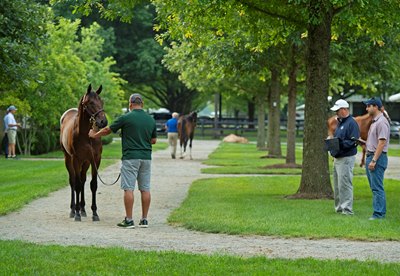
A yearling is inspected at Fasig-Tipton ahead of The July Sale
A day before two days of selling begin at Fasig-Tipton's Newtown Paddocks in Lexington, a panel of veterinarians and horsemen gathered in the sales pavilion to discuss what issues in veterinarian reports buyers may be able to overcome when purchasing a sales horse.
Called "Deal or No Deal?" the question and answer panel held July 11 on vet findings in sale yearlings was presented by the Consignors and Commercial Breeders Association and the Kentucky Thoroughbred Farm Managers' Club. Speakers Dr. Nathan Chaney, Dr. Robert Cook, Dr. Keith Latson, trainer Kenny McPeek, and Watercress Farm bloodstock adviser Rob Tribbett responded to questions presented by CBA members. The panel was offered as an educational opportunity ahead of The July Sale, Fasig-Tipton's selected yearlings sale to be held July 13, and was also streamed online.
McPeek, who has a strong reputation for buying overlooked horses that become successful on the racetrack, said he tries to avoid "analysis paralysis" when examining horses' vet reports on the sales grounds.
"I think that buyers need to be a little more open minded; they need to listen to their veterinarians but they need to not let small findings keep them from their chance of maybe buying the next champion," he said.
McPeek said the conformation of a horse comes first for him, then he checks the information on a vet report to see how a horse should be handled.
"I'm lucky in that over the course of my career, when I buy a horse I get to take it through the process of developing and seeing which horses and where they have problems," he said. "Nathan does my vet work. When I get a horse that I'm really crazy about and he comes back and says 'OCD (osteochondritis dissecans) in the stifle' I'm like 'OK, that's not one I can go for.' But I believe Swiss Skydiver had OCDs in her hocks, something like that. It wasn't enough to turn me off."
Swiss Skydiver, a $35,000 Keeneland September Yearling Sale purchase in 2018, earned champion 3-year-old filly honors for 2020 after defeating males in the Preakness Stakes (G1).
"I'm more worried about the physical structure of the horse, then it's more of a matter of what can I handle? What can I deal with?" McPeek added. "Can I deal with spurs in the knees? Eskimo Kisses had spurs in the knees. They turned her down, completely. Curlin had an OCD in an ankle the size of a dime, and when I bought him, I had two vets come and look and said 'what's the prognosis?' and they said 'give him time, he'll be fine.'"
Eskimo Kisses won the 2018 Alabama Stakes (G1) and the following year sold to Shadai Farm for $2.3 million at the Keeneland November Breeding Stock Sale. McPeek, as agent, bought Curlin for $57,000 at the 2005 Keeneland September sale, and the horse went on to be a two-time Horse of the Year that earned more than $10.5 million and is now a leading sire.
The panel across the board noted many buyers are looking for a perfect specimen with no issues on its vet report at sales, often bypassing horses who later have no problem performing on the racetrack.

"People come up and look at (a horse's) sheets and see comments on the reports they either don't understand and they think the horse has problems that make the horse unsuitable for purchase," said Cook, who noted any radiograph findings must be reported. "I think everybody that buys horses needs to understand that these reports are radiographic findings that may or may not be significant to the horse's soundness long term or ability to pinhook."
Cook said often buyers will see a report with a lot of writing on it and walk away from a horse.
"Not purchasing a horse because it has an OCD or a P1 chip, those are, to me, in my mind, not often a good choice if you like the horse otherwise because you can often buy it at a slightly reduced rate," he said. "Once the horse is cleaned up, most of those lesions are never significant for the horse, particularly hock OCDs which are probably the most common ones. OCDs off the back of P1 in the hind fetlock are often quite common; those are easily removed and the horses rarely have an issue with them once removed.
"If we can fix it with an excellent prognosis, I don't see any reason not to purchase it."
Cook also suggested looking for words such as "moderate," "mild," or "severe" to help determine the extent of a finding on a horse's vet report, such as with sesamoiditis.
Latson noted that the sesamoid bones are pulled in two directions as a horse takes a step.
"What we have to expect is that a bone under that kind of stress and that small of a bone has got to have some adaptive change over time. When I see sesamoiditis in a yearling, I expect to see some level of sesamoiditis. I expect to see some level of sesamoiditis, although at a reduced rate, in a 2-year-old," Latson said. "Sesamoiditis is not a four-letter word for me when I'm looking at horses. It can be a sentinel for other things that are going on when we start getting into mild-to-moderate and moderate-to-severe sesmoiditis. It's very rare that I'll look at a horse that has severe sesamoiditis, in my view."
Latson said he scans about 20% of the sales horses he looks at for sesamoiditis, looking for irregularities in the radiographs when deciding if to do so. He estimated 80% of radiographs he sees at sales show horses going through regular adaptive change.
"Yearlings are healing machines," he said. "Even if we have a finding of sesamoiditis, if it scans well, then we may be in a good position if we have that conversation with our client and say 'look, in terms of longevity we're still in good shape here but it may affect how we manage this horse out of the sale.'"

Tribbett represented commercial breeders on the panel and advises the successful breeding partnership of Fred Hertrich III and John Fielding as part of the team at Hertrich's Watercress Farm He emphasized the importance of a good relationship between buyer and vet, which could help a buyer determine what problems they are able to manage or those that are likely to resolve in a sales horse.
In the last few years, Hertrich and Fielding have been represented as breeders by grade 1 winners Catholic Boy , Diversify , Maxim Rate , and Rushing Fall . Even with the reputation of producing top runners, they have sales horses on a regular basis that are punished in the auction ring for small issues on their reports, Tribbett said.
"What impacts a horse on the track and what impacts him in the ring have unfortunately become very disparate things," he said. "Every horse that goes through the ring has a lot of risk in its future racing performance. How much of that can we really tie back to a yearling survey that we're taking one snapshot of the horse right before a sale and we're trying to look in a crystal ball and say this horse will make it to the track/will not make it to the track?"
Asked about well-performing 2-year-olds that prove their soundness at juvenile sales but had questionable radiographs as a yearling, Chaney said he would still recommend a buyer pursue a horse if it had an issue such as hind ankle chips, upper knee joint spurs, or sesamoiditis and scanned well.
"Most of the time I found, other than a couple lesions on X-rays, that what we see at the sale, especially as yearlings, don't really stop a horse on the racetrack," Chaney said.
"A lot of these lesions that we see on these X-rays are really not that significant as yearlings, especially if they can make it to a 2-year-old sale and perform well and have a normal physical," he added.
The panel also covered scoping horses at sales and not getting scared off when a horse does not have a grade 1 throat, that being a throat in which the arytenoids open symmetrically.
"People are looking for that grade 1 throat," Cook commented. "I think Scott Pierce published a really good research paper on throats and how they change over time. A vast majority of them don't. They stay the same or get better. Most of them don't get worse."
Cook added that most horses fall in the 2A range (mild asymmetry) for throats and that many in the 2A and 2B (moderate asymmetry) range go on to race. While the grade might make it worth checking a video endoscopic exam at a sale, it's not a reason to turn away from a sales horse.
Latson added that most of the horses he had scoped in the 2A or 2B range did not require tieback surgery.
"A 2A throat is a perfectly fine racing throat," he said. "A 2B throat, if I include that nostril and that horse has a nice huge throat, that doesn't take the horse off the table for me."