
Study: Equine Therapy Shown to Help Veterans With PTSD
Image:
Description:
Photo: Courtesy Man O' War Project
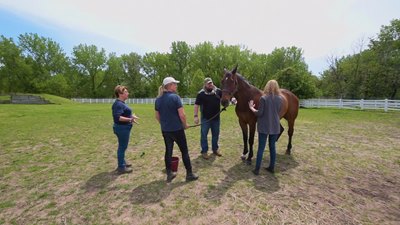
Veteran Sgt. Matt Ryba visits with an off-track Thoroughbred
A study published Aug. 31 in The Journal of Clinical Psychiatry found that manualized equine-assisted therapy for post-traumatic stress disorder shows promise as a potential new intervention for veterans with PTSD.
The research was conducted by Dr. Yuval Neria and Dr. Prudence Fisher, both co-directors and principal investigators of the Man O' War Project at Columbia University Irving Medical Center. The Man O' War Project is the first university-led research study to explore the use of and scientifically evaluate equine-assisted psychotherapy in treating veterans with PTSD, which includes developing a well specified treatment manual—the first of its kind—which will be made available to the field.
For this study, a recently developed and manualized eight-session group EAT-PTSD was tested in an open trial to assess its preliminary feasibility, acceptability, and outcomes for military veterans. The study found that it appears safe, feasible, and clinically viable. The preliminary results encourage examination of EAT-PTSD in larger, randomized controlled trials.
"Our findings that both PTSD and depressive symptoms significantly improved are very exciting because we demonstrated that our treatment is a viable alternative or supplemental treatment for those who suffer from PTSD," said Fisher. "Importantly, the veterans liked the treatment and completed the protocol, which is not the case for many other PTSD treatments where dropout rates are high. Finally, because we created a manual for the protocol, the first well-specified treatment manual for any EAT treatment, it can be taught to others in the field."
 (L-R): Dr. Yuval Neria and Dr. Prudence Fisher
The study was conducted from July 2016 to July 2019. Sixty-three treatment-seeking veterans with PTSD enrolled. PTSD diagnosis was ascertained using the Structured Clinical Interview for DSM-5, Research Version and confirmed using the Clinician-Administered PTSD Scale (CAPS-5). Mean age was 50 years, and 23 patients (37%) were women. Clinician and self-report measures of PTSD and depression were assessed at pre-treatment, mid-treatment, and post-treatment and at a three-month follow-up. An intent-to-treat analysis and a secondary analysis of those who completed all four clinical assessments were utilized.
Thirty-two patients (50.8%) showed clinically significant change (≥30% decrease in CAPS-5 score) at post treatment and 34 (54%) at follow-up. Post-treatment assessment revealed marked reductions in both clinician-rated and self-reported PTSD and depression symptoms, which persisted at three-month follow-up. Specifically, mean CAPS-5 scores fell from 38.6 (8.1) to 26.9 (12.4) at termination. Only five patients (8%) withdrew from treatment, four before mid-treatment and one afterward.
The Man O' War Project began in 2015 with funding from philanthropist ambassador Earle Mack, a veteran himself, and longtime Thoroughbred owner/breeder, who was concerned about the mental health crisis facing veterans and his observation of anecdotal stories from various equine-assisted therapy groups, with no hard science to support their claims. Mack approached Dr. David Shaffer, former director of the Division of Child and Adolescent Psychiatry at the Columbia University/New York State Psychiatric Institute and soon a team was formed, led by Fisher and Neria.
"We are so thrilled to see the results of this scientifically validated EAT study, which gives new hope to our brave veterans so deserving of our support. In addition, we have every reason to believe this protocol will be adaptable to other groups suffering from trauma, anxiety, or PTSD," said Mack. "So many people have been impacted by recent events and the pandemic has made things even more difficult for all age groups. This study shows great promise that we can help not only our veterans but others facing anxiety issues and mental health challenges."
The Man O' War project has been supported by the Earle I. Mack Foundation, The Jockey Club, the David and Julia Koch Foundation, the Nicholson Family Charity Fund, the Mary and Daniel Loughran Foundation, the Viola Foundation, Gulfstream Park Racing Association, Gerald Parsky, Peter Brant, the Ganek Family Foundation, the Live Oak Foundation, the Reid Family Charitable Fund, Meta Aerospace Capital, LTD, and Tactical Air Support.