
U.S. Attorney Outlines Doping Case That Built on Itself
Image:
Description:
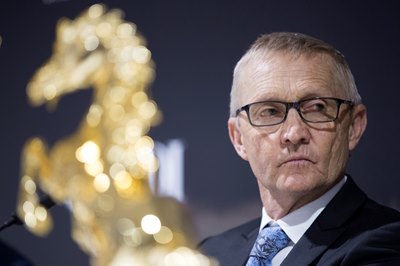
Photo: Jockey Club of Saudi Arabia/Mahmoud Khaled
Jason Servis and 10 other defendants are asking for a federal court to suppress certain communications collected by wiretap
In arguing that wiretaps of several individuals were properly obtained in a case that would eventually see 27 people indicted last year on charges related to distributing and administering performance-enhancing drugs in horse racing, the United States Attorney for the Southern District of New York outlined a network of individuals with extensive knowledge of doping horses and evading detection.
In a 155-page filing Sept. 2, U.S. Attorney Audrey Strauss outlined a case that built on itself as a wiretap of trainer Jorge Navarro—that wiretap already has been found to be legal—brought additional persons of interest into the investigation. Intercepted conversations between Navarro and prominent trainer Jason Servis, discovered in the Navarro wiretap, was one example of how the case built on itself, and, the Attorney argues, were important evidence in justifying further wiretaps.
 Jorge Navarro
The wiretap of Navarro already was allowed into court and the trainer pleaded guilty to charges related to performance-enhancing drugs Aug. 11. Now 11 other defendants, including Servis, are attempting to suppress evidence obtained from their premises, cellphones, and electronically stored information.
In a Sept. 2 court filing, the U.S. Attorney says that a wiretap of Navarro's phone indicates Servis was actively assisting Navarro to conceal Navarro's doping practices by "tipping off" Navarro to the presence of racetrack officials. The recordings also suggest, according to the U.S. Attorney, that Navarro confided in Servis regarding his own doping practices and about a corrupt relationship he had with an unnamed track official.
Furthermore, the U.S. Attorney alleges that the conversations suggest that Navarro believed Servis also had a corrupt relationship with a racetrack security official and that Servis further participated in Navarro's doping scheme as a recipient of an unspecified, irregular version of clenbuterol.
The U.S. Attorney argues that at the time of the initial Servis wiretap on April 30, 2019, the evidence made amply clear that Navarro, Servis, and others understood a substance known as SGF-1000 was performance-enhancing. In making that argument, the U.S. attorney offered a March 5, 2019 conversation between Navarro and Servis in which Navarro seeks advice on additional substances, Servis talks about his use of SGF-1000, and Navarro expresses concern about discussing such topics on the phone.
Navarro: And if you know something new, if you know about something new, don't forget about your man OK? Don't forget about your man.
Servis: I'll tell you what Jorge, I'm using that (expletive) shot, what is it SGF?
Navarro: Oh yeah, yeah, yeah. I got uh; I got more than 12 horses on that so I'll let you know OK?
Servis: I've been using it on everything almost.
Navarro: Jay, we'll sit down and talk about this (expletive). I don't want to talk about this (expletive) on the phone OK.
Servis: All right. You're right.
KING: U.S. Attorneys: Sufficient Probable Cause for Wiretaps
In the indictments, the substance SGF-1000 came to light. SGF-1000 is a formulation of amino acids reported to have been derived from sheep placenta that was compounded and sold in Kentucky by Medivet Equine and Tailor Made Compounding, a company not affiliated with Taylor Made Farm. The product was marketed to accelerate healing and have an anabolic effect on bone growth in horses. It has been reported to contain peptide-based substances and other substances which may evade current testing.
The court filing from the U.S. Attorney argues that while defendants Servis and Alexander Chan say a drug testing laboratory's examination of SGF-1000 raised questions about the substance's actual performance-enhancing effects—saying the study found no actual growth hormones—Servis and former New York-based veterinarian Kristian Rhein "fully understood SGF-1000 to have performance-enhancing effects." (The U.S. Attorney also noted that additional testing found the presence of a specific growth hormone in SGF-1000.)
 Dr. Kristian Rhein
Rhein pleaded guilty Aug. 3 to federal charges related to administering and distributing adulterated and misbranded performance-enhancing drugs to Servis and then hiding his activity from regulators.
In the U.S. Attorney's Sept. 2 filing defending the use of wiretaps on Servis and the other defendants, it offers a recorded phone call in which Rhein expresses concern that SGF-1000 does contain growth hormone in addition to the advertised "growth factors.
The U.S. Attorney again presented the conversation between Rhein and Servis, released at the time of last year's indictments, where Rhein expresses confidence that labs will not detect SGF-1000 and if they find anything, it will come up as "dex" (dexamethasone). The U.S. Attorney also states that intercepted conversations suggest that Servis later called another individual to falsely list "dex" on his veterinary records to obscure his use of SGF-1000.
From the Servis wiretap, the U.S. Attorney notes a conversation between the trainer and his assistant Henry Argueta that allegedly outlines the administration of unspecified drugs and specifically joked about Argueta's supposed method for covertly discarding drugs if needed.
Argueta: Yeah, I take a shower and put it on my body (laughs).
Servis: Right, so you just put it in a cup and then you have your little syringe … Right that stuff is good, huh?
In justifying the wiretap of Servis, the U.S. Attorney cites early interceptions from the Navarro wiretap of Servis discussing clenbuterol and an "irregular" version of clenbuterol. Clenbuterol is allowed as a controlled therapeutic for treatment of airway issues but because of its anabolic potential its a substance of high concern and its withdrawal time has been pushed to 28 days under racing's current model rules.
A New York State Gaming Commission study of medical records of horses previously trained by Navarro and Servis last year following the indictments found that 77% of horses they previously raced in the state had been administered clenbuterol. The U.S. Attorney said use of clenbuterol or "irregular" clenbuterol was one of several avenues of investigation furnishing probable cause.
The U.S. Attorney offered a July 10, 2019 conversation between Servis and Argueta in which Servis allegedly directly acknowledges the problems with the use of that substance. Servis-trained Maximum Security had reached the wire first in the Kentucky Derby Presented by Woodford Reserve (G1) that year but was disqualified for interference in the far turn. Still, the performance had brought added attention to Servis.
Servis: Be careful man. Henry with that. Really careful.
Argueta: Yes.
Servis: Because we are getting really good.
Argueta: Yeah, no ("Yeah, I know").
Servis: All we need is a problem like that. Oh with the Derby and (expletive). Oh my God.
Argueta: Yeah, then they are looking for us in the tree.
Servis: Yeah they will.
Argueta: They are going to be in the tree looking for you with their binoculars. … They'll be over there. They be there looking for you.
Servis: No, they'll be in a can or a car with black windows you won't be able to see in.
Argueta: Haha.
Servis: You know what I am saying. But they can see out.
Argueta: Yeah, but (what) are they going to see. Nobody is going to see nothing. What are they going to see? Nothing.
Servis: Right.
Argueta: We don't do nothing, ha ha. They can look wherever they want to look.
Servis: It means that Clen is supposed to be for Sunny Ridge .
Argueta: Yeah, but what; it's legal.
Servis: I know but (an individual) told me it's supposed to be for whatever you got the prescription for.
Argueta: Yeah it might be having a problem but it's legal.
Servis: Yeah but it's not. In New York it's supposed to be for a horse you have a prescription for and you have to get permission from the gaming commission to even get a prescription.
Argueta: Yeah I know. Yeah, that's a little problem but the rest … it's little; it's not like you're doing something very illegal.
Servis: Yeah but I know but what I'm saying is they (inaudible) it out.
Argueta: The only problem you get is what you don't report about it. That's it.
Servis: Yeah, it's not reported right.
Argueta: That's it. What else can they do?
Servis: Well, they might do (expletive).
Arugeta: OK.
Servis: Got to be careful.
Argueta: Yup.
Servis: Like Navarro is doing it at midnight.
The U.S. Attorney concludes that the conversations make plain that the reviewing courts reasonably found probable cause that the Servis and Rhein phones would be used to communicate a scheme to obtain money and property by means of false statements and fraudulent pretenses through the use of interstate wires or shipments in mails, i.e., a scheme to commit mail and/or wire fraud.
Another one of the defendants, veterinarian Seth Fishman, argues that the evidence should be suppressed because he "merely discussed the permissible administration of medications to racehorses," but the U.S. Attorney says a Jan. 25, 2019 recording of Navarro suggests Fishman had supplied an injectable drug that most assuredly improved performance. Navarro says, "This crazy (expletive) Seth…sent me something with amino acid right last year. And I (expletive) gave it to this horse. This (expletive) galloped. Galloped."
Fishman is facing charges related to developing and distributing multiple PEDs.
In a Jan. 27 phone call between Navarro and Fishman, the U.S. Attorney says Navarro asks Fishman for "that amino acid injectable (expletive) that you sent me, which prompted Fishman to later inquire whether Navarro could be more specific because Fishman had "hundreds of products."
The U.S. Attorney notes that in this conversation, Navarro never says which specific horse needs to be treated and Fishman did not try to identify a specific horse but instead referred to his deep catalog of drugs and "hundreds of products."
"His questions were geared towards fulfilling an order for drugs, not in treating a horse," the filing argues. "This call supported probable cause on the basis that this and other conversations were fundamentally inconsistent with a licensed veterinarian providing care to an animal but more akin to a drug dealer servicing a notorious racehorse trainer like Navarro."
In a wiretap of Fishman, the U.S. attorney alleges that in a number of calls the vet talks about substances he has available that are not detectable to testing labs. In a March 7 call he allegedly tells a potential customer that, "unless somebody turns you into the race jurisdiction, no one is going to test for it because it's not known until it is known."
The U.S. Attorney says in an April 17 call with a potential customer Fishman responded to a question asking if administration of a substance amounted to doping. "Of course it's doping, the question is it testable doping. … Anytime you give something to a horse, that's doping. Whether they test for it or not, that is another story."
An Aug. 2 motion filed by Servis attorneys Rita Glavin and Michael Considine seeks to suppress the wiretap evidence. They wrote that federal investigators made "deliberately or recklessly false statements" regarding an alleged performance-enhancing substance called SGF-1000 and the bronchodilator clenbuterol. Additionally, they argued the government had not exhausted other traditional investigative techniques before requesting the authority to conduct wiretaps and claimed the government used information from "previous illegal wiretaps" to gain authorization to intercept calls to Servis' phone.