
Hochul Considers Bill for NYRA Trainers' Insurance
Image:
Description:
Photo: Skip Dickstein
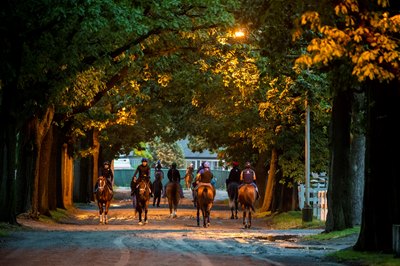
Horses head to the track and back during morning training at Belmont Park
New York Gov. Kathy Hochul is considering legislation to permit a portion of purse money derived from video lottery terminal revenue sharing proceeds to be used to finance a new program giving access to health insurance for trainers who commit to be regulars on the New York Racing Association circuit.
"This is industry money taking care of an industry program. We're not asking anyone for a dollar outside of what would already come into racing,'' said Joseph Appelbaum, president of the New York Thoroughbred Horsemen's Association.
The legislation was approved last May by the state Legislature and sent to Hochul on Sept. 28, meaning she will act on the measure by the end of the week.
Appelbaum said improving health insurance opportunities for horse trainers, especially for smaller operators, was especially revealed during the past two years of the COVID-19 pandemic.
"New York can be very lucrative when in small business, but it can also be very difficult,'' Appelbaum said of the costs of health insurance.
The measure would provide access to a health insurance plan for trainers who have at least 43 NYRA starts in a year, and for whom 60% of all their starts are at Aqueduct Racetrack, Belmont Park, or Saratoga Race Course. "We want to encourage people to partner with us and reward those loyal to our circuit,'' Appelbaum said.
 NYTHA president Joseph Appelbaum
NYTHA estimates 65 trainers in the first year of the program will qualify, but that over time, it will draw more trainers to race at NYRA tracks. In the beginning, the horsemen's group estimates the insurance program will end up resulting in some 250 to 300 additional starts and a boost in handle by about $40 million to $50 million.
"With the additional handle, the purse account replenishes itself, the state gets more tax dollars, and NYRA gets more funding and it's a better ecosystem, hopefully, for attracting more trainers,'' the NYTHA president said.
NYRA spokesman Patrick McKenna said the racing corporation "fully supports" the legislation "as a commonsense approach to expanding health insurance coverage for trainers based in New York."
"If enacted, this legislation will reduce the cost of doing business and provide a clear incentive for trainers to participate more frequently in New York racing,'' he said.
The measure was sponsored by Sen. Joseph Addabbo of Queens and Assemblyman Gary Pretlow of Westchester County; the Democrats are the chairs of the Senate and Assembly racing committees.
The cost estimates of a new health insurance won't be fully known until the plan is put out to bid to health insurance administrators and costs for specific coverage levels are determined. But Appelbaum noted a rule of thumb for coverage in the metropolitan New York area costs about $15,000 to $20,000 per person; he said it will likely also serve as a supplement for many of the eligible trainers who are over age 65 and already on Medicare.
Appelbaum said the idea will help NYRA compete with Mid-Atlantic tracks for trainers.
"Trainers have a lot of choices. We view this as one tool in our shed to get them here,'' he said of a program backers hope will both retain and attract trainers.
The plan, affecting only trainers at NYRA tracks, needs state approval because only the Legislature and governor can determine how the VLT proceeds are used. In this case, up to 3% of purse account funds, which Appelbaum previously projected would be somewhere under $1 million a year, would be directed to pay for the health insurance program.
The legislation permits insurance coverage up to "silver" levels, though more comprehensive coverage can be obtained if the insured person pays the difference. If approved by the governor, a memorandum of understanding will still need to be approved between the NYTHA and NYRA, which then also must get OK'd by the State Gaming Commission.