
Symposium Speakers Discuss Combating Decoupling
Image:
Description:
Photo: Race Track Industry Program/Veronica Rodriguez, OIA
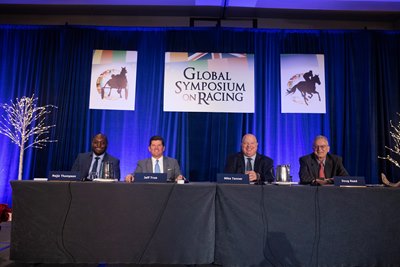
(L-R): Najja Thompson, Jeff True, Mike Tanner, and Doug Reed for The Decoupling Debate panel at the Global Symposium on Racing
With states constantly looking to close budget gaps, racetracks that depend on funds derived from casino gambling are increasingly nervous that lawmakers could raid their purse accounts. A recent bill introduced in New York, for instance, proposes redirecting legally protected video lottery terminal payments to more popular needs like public schools, agricultural grants, human services, and workforce protections.
A Dec. 8 afternoon panel at the University of Arizona's Race Track Industry Program's Global Symposium on Racing, termed "The Decoupling Debate," addressed strategies for combating such efforts, with education and lobbying emerging as the key strategies.
Moderator Doug Reed, the racetrack business consultant and former director of the RTIP, stressed the need to understand racing's opponents, who will typically argue that so-called subsidies to racing have not realized the intended impact.
"The audience for these arguments isn't the industry; it's the politicians and the people," Reed said.
Mike Tanner, executive vice president of the U.S. Trotting Association, has watched the sun set on harness racing in Florida due to the decoupling of slot machines from the requirement that a casino host live racing. Isle Casino Pompano Park, known as the Winter Capital of Harness Racing, is expected to discontinue racing once the current season ends in April. Decoupling also helped to seal the fate of Florida's greyhound tracks.
"There was a great graphic that came out of Florida showing where the money from a wager goes," Tanner said. "It's impossible to expect the public to understand those economic intricacies."
Tanner pointed to the "We Are NY Horse Racing" campaign—a collaborative effort between nearly 50 organizations that depend on live horse racing—as the best example yet of how to present the most helpful image of racing to the public.
"It humanizes the sport," Tanner said. "We tell the story over and over to ourselves but we have to find better ways to tell it to the public. It's a lot more compelling to share the story of the groom who put herself through college than to see Mike Repole or Vinnie Viola taking down another million-dollar purse."
Najja Thompson, executive director of the New York Thoroughbred Breeders, was part of the core group behind "We Are NY Horse Racing."
"In anticipation of attacks on the industry, we sat down with (the New York Racing Association), the horsemen, and the Standardbred groups, as well, to make sure the entire industry could be represented in telling our story and getting ahead of these battles," he said.
Consultant and longtime track executive Jeff True emphasized the need to continually invest in the community and the political process. If an organization waits until a crisis to do those things it will be too late to build the relationships and goodwill necessary to fend off challengers.
 Jeff True at the Global Symposium on Racing
"First, we have to stop using the word 'subsidy,'" True said. "Most of us in racing would agree that if the racetrack is investing in a casino, buying the machines, building a marketing plan, and some of the gross revenue goes to racing, how is that a subsidy?
"There's a need for racing operations to get involved in their community and their state and become good corporate citizens as a way of defending against these attacks. You can only have those good stories to tell if you're getting involved in the community. Those things tend to defer the 'subsidy' arrows that we get. Civic philanthropy is required of any good corporate citizen. It's not just saying, 'We love horses,' it's also, 'We love people,' and loving the people in your community because you're all a part of it."
Lobbying at the state level is not for amateurs, True said, and at some point always proves worth the investment.
"You've got to set aside a certain amount of money for preservation," he said. "Professional legislative representation is an absolute necessity. It's got to be one of the disciplines of our practice. You've got to establish the legislative journey now."
Tanner concurred: "It's far and away the most important thing a professional horsemen's organization can do."