
Equine Fatalities at Golden Gate Fields Concern CHRB
Image:
Description:
Photo: Vassar Photography
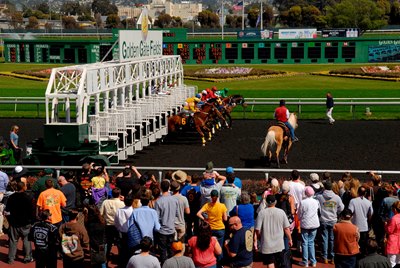
Horses break from the gate at Golden Gate Fields
With board members troubled by what they deem a high number of equine fatalities at Golden Gate Fields, the California Horse Racing Board during its monthly meeting Dec. 15 narrowly approved an upcoming six-month license for the Northern California track.
Three commissioners—vice chairman Oscar Gonzales and board members Wendy Mitchell and Brenda Davis—preferred giving the Northern California track a three-month license followed by a review. In the end, support for the standard six-month license, backed by board members Dennis Alfieri, Damascus Castellanos, and Alex Solis and chairman Dr. Greg Ferraro, won out (a 4-3 vote) with promises that the CHRB would review the track monthly.
According to CHRB statistics, nine of Golden Gate's 26 fatalities were classified by the CHRB in a category called "other." Fatalities from barn accidents and colic are examples that fall in that classification. Ponies accounted for three deaths.
Seventeen racehorses have died in racing (four) or training (13) at Golden Gate this year, a fatality total below that at Santa Anita Park, where 19 horses have died following racing or training injuries. Four of the deaths at Golden Gate occurred in November.
Both tracks are open for training over much of the year and have a high number of race dates relative to other state tracks. Golden Gate has a synthetic Tapeta main track; Santa Anita a dirt surface. Both also run turf races.
The CHRB majority favored giving Golden Gate its standard license, with Ferraro noting that the regulator has the authority to stop racing under its current regulations. Commissioners then argued whether they had the votes to take such action when the CHRB pressured Los Alamitos Race Course to improve its instances of equine fatalities earlier this year. Safety numbers at Los Alamitos have since improved.
Gonzalez noted that The Stronach Group, which owns Golden Gate, Santa Anita, and other racetracks across the country, opted to suspend racing this month to review the main track at its Laurel Park property in Maryland following an increase in breakdowns.
"So at what point does a company afford California and the public, and racing, that same important gesture?" he posed to his fellow commissioners.
Alfieri defended TSG, mentioning that they suspended racing for a period at Santa Anita after a spike in fatalities in 2019.
Ferraro indicated that he, executive director Scott Chaney, and equine medical director Dr. Jeff Blea were at Golden Gate last week. Later in the meeting during his report, Blea mentioned the visit to Golden Gate, in which the CHRB attended a horsemen's town hall.
"We spoke to horsemen about different protocols to help understand why they were having an increase of injuries in training, and more important, how to reduce the incidence of injuries," he said.
The CHRB also approved a six-month license to Santa Anita, which submitted an amended application to add racing Dec. 27 and Dec. 30, but drop cards April 22-24 and April 29. The Santa Anita and Golden Gate applications were approved without signed agreements between TSG and California Thoroughbred Trainers. The CHRB applied previous agreements.
Also during the meeting, Blea gave an approximate timetable of two months for a completed necropsy of Medina Spirit, who died off a suspected heart attack after a workout last week.
Chaney noted in his remarks that the CHRB would soon rejoin the Association of Racing Commissioners International. It departed ARCI a few years ago "based largely on philosophical and political differences," Chaney said, but will return next year "with national horse racing legislation on the horizon."
He issued a reminder that the CHRB will begin instituting two new rules Jan. 1: a strict regulation of thyroxine, a thyroid medication; and a requirement that horses undergo a veterinary soundness examination within 72 hours of a workout or race.