
Delta Downs Trying to Light a Way to Safe Night Racing
Image:
Description:
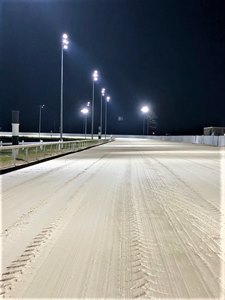
Photo: Courtesy Delta Downs
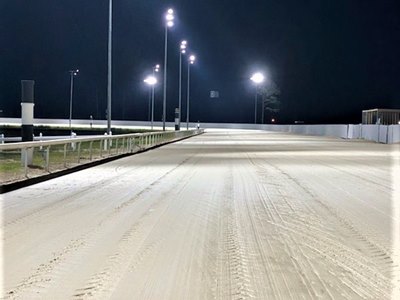
The track at Delta Downs under its new lights in early December
A better lighting system at Boyd Gaming's Delta Downs in Southern Louisiana has not been good enough for the track to restore its valuable two nights of racing per week.
The racetrack lost its lighting during the devastation from Category 4 Hurricane Laura in August 2020 and consequently its most valuable real estate in the national pari-mutuel simulcast landscape. A new lighting system was unveiled in October, which one expert has called "exceptionally better than in the past," but the Delta Downs jockey colony has not been happy with the results, calling an uneven spread of dark and bright spots around the track dangerous to both horse and rider.
The Louisiana Racing Commission considered the issue Dec. 13 during a hearing to consider a Delta Downs request to convert two of its four weekly racing days from afternoon to night.
Steve Kuypers, vice president and general manager at Delta Downs, said the track has made extensive changes to the lighting system since jockeys first expressed their concerns back in October. He said a contractor added brackets to 36 light poles and attached 64 additional LED lights to those brackets. Project managers then walked the track with jockeys and trainers to re-aim the lighting in order to even out the illumination.
Boyd then hired John Stewart, owner and founder of Encompass Development Design and Construct, to evaluate the lighting conditions. Encompass did the track and infield lighting for Churchill Downs and has worked on racetracks in eight other states.
"I conclude that the new lighting, based on photos and testimony of those that were at the track before the hurricane, is tremendously better than what existed before. Better in being closer to daytime racing light colors, lighting levels, and consistency around the track. And, based on my observations at other tracks in the U.S., better than most of those as well," said Stewart in his report.
Stewart also noted: "Horse race track lighting is not a highly researched subject. While I have made observations and recommendations, it is ultimately up to the horse owner, trainer, and jockey to determine if they feel safe riding and racing their horse at each track under lighting, weather, and other conditions. The most important thing to me in racing is the safety of those involved, including the horses."
This latest point is where Delta Downs and the jockeys diverge.
"While we recognize and appreciate the efforts made by Delta … there are still some grave concerns. It is not the amount of lighting per se. It is more inconsistencies with the distribution of light and the various shadows and hot spots on the racetrack," said Mindy Coleman, representing the Jockeys' Guild, during Monday's hearing. "In racing, there are incidents where horses will spook and jump at shadows. There have been multiple votes and discussions with the colony. They still don't feel safe."
Kuypers noted that horses have been working at the track during the morning under these lights without complaint or incident. He got support from Bernard Chatters, president of the Louisiana Horsemen's Benevolent and Protective Association, who said the track now has a "fabulous" lighting system and should be able to start running at night.
 Racing under the lights at Delta Downs in 2020
Jockey Ty Kennedy said galloping in the morning and racing at night are not comparable.
"Yes, we do train under these lights every morning, however, racing a horse by yourself is a lot different than riding in a race with nine other horses. If you take half a path out in in the morning you don't affect anybody. But when you have that ship-in horse that doesn't train under these lights and has never seen these shadows, that could create a potentially hazardous situation," Kennedy said.
Kennedy also noted that the riders at Delta Downs also compete at night at Turfway Park, Canterbury Park, Sam Houston Race Park, Remington Park, and Prairie Meadows, and others.
"We have not seen shadows like these at any other racetrack," he said.
Jockey Tim Thornton said all the riders understand how important night racing is to Delta Downs and none of them have any issues with simply riding at night.
"Honestly, we want to make money. If the lights were completely fine, we'd run at 2 in the morning," he said. "The handle is a big issue, but we don't feel our safety should be in jeopardy because of the handle going down."
Photos of the track lit up at night were provided to commissioners to review but the images were not clearly labeled as to when they were taken, so questions about how current they were or if they'd been taken before adjustments had been made went unanswered.
Then when commissioner and Hall of Fame jockey Eddie Delahoussaye spoke, the other commissioners listened.
"If it is not safe and the riders don't want to risk their lives, then let them run during the day. If someone gets killed, I don't want that on my head," Delahoussaye said. "I think we need to research this more before we OK this."
After an hour of testimony, the commission voted unanimously to postpone for 30 days a decision regarding restoring Delta Downs' night schedule. In the meantime, commissioners requested better, more clearly labeled photos and asked Jockeys' Guild representatives to find another expert to evaluate the lighting.
"I am not looking for a counter to Boyd," said Ben Guilbeau Jr., commission chairman. "I'm looking for a solution, someone that can provide a different path."
The day after the hearing was full of phone calls, said Kuypers, who added that track executives were evaluating all the issues raised during the hearing in order to identify the next steps forward. It is important, he said, for that path to eventually restore nighttime racing.
"Delta Downs has always been a nighttime track, and we have a strong following at night," Kuypers said. "Because we are a casino, there is more excitement at night than during the day. What's most important is for Delta to have racing. It is imperative for us to have racing."