
Gait Sensors at NYRA Could be Game Changer for Injuries
Image:
Description:
Photo: Coglianese Photos
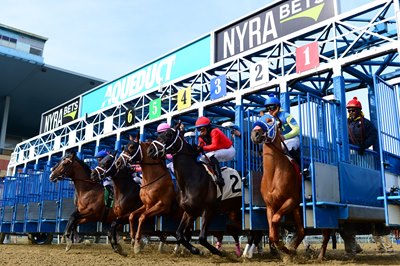
Horses break from the gate at Aqueduct Racetrack
As much as winter racing in New York may not offer as much drama and excitement as summers at Saratoga Race Course, something of extreme importance to the entire sport and the welfare of its equine athletes will be taking place this winter at Aqueduct Racetrack.
An innovative program involving each race and runner at Aqueduct is underway, using sensors to analyze the gait of racehorses in hopes of spotting musculoskeletal injuries or abnormalities before they lead to a serious or catastrophic injury.
"I think this is going to be a game changer in terms of screening horses for pre-existing gait abnormalities and it will send up flags that a horse needs to be examined," said Dr. Scott Palmer, the New York State Gaming Commission's equine medical director. "This shows us that the horse is doing something very unusual as it runs and it needs to be looked at."
 Dr. Scott Palmer, New York State equine medical director
The program, a joint venture involving the New York Racing Association, the New York Thoroughbred Horsemen's Association, and the NYSGC using a device developed by StrideMASTER and the Kentucky-based Equine Analysis Systems, was launched this summer at Saratoga. Horses were originally equipped with the small three-ounce StrideSAFE sensors in a saddlecloth in one race per day.
It was expanded to its current state of every NYRA race with the start of the Belmont Park fall meet and also includes morning workouts by horses from a handful of trainers. All told, thousands of horses have been monitored, providing a wealth of data that can both pinpoint an existing problem and create baselines so that changes in a horse's gait can be quickly detected.
"This is a proactive step. We are capturing data that we can review and at this point what we have collected so far has been very useful and it's something we will build on. This is something that will develop and evolve. There's no question we're just scratching the surface with this," said Glen Kozak, NYRA's senior vice president of operations and capital projects. "If this saves just one horse it's worth it. When I went to (NYRA CEO and president) Dave O'Rourke to discuss implementing the program, he was fully supportive of it. We brought in the horsemen and (NYTHA president) Joe Appelbaum has been fantastic. It's already been a highly helpful program."
 Glen Kozak, NYRA's senior vice president of operations and capital projects
Appelbaum said horsemen have embraced the concept, realizing the benefits of detecting a minor issue with a horse's stride and treating it before a serious injury occurs on the racetrack.
"I think everyone is very excited about what this technology can bring to us. Every trainer we've asked was willing to do it and enthusiastic about it. We need to use every technological feature we can find to improve the health and welfare of our horses," Appelbaum said. "It revealed issues which were able to be treated by a further veterinarian exam."
Physiologist Believes Sensors Could Protect Racehorses
According to Palmer, there have already been several instances in which the data has provided trainers with crucial information about a developing issue reflected in a horse's stride, leading to treatments that likely prevented a breakdown. In each of those cases, the problem was not obvious and apparent to anyone involved with the horse and was detected by StrideMASTER's breakthrough technology.
"We're looking at their gait, using a GPS device that is a sensor—a very accurate sensor that sends out a signal to a satellite at a rate of 2,400 bytes of information per second. So, we get a very accurate measurement of a horse's gait during a race. Each horse has an individual fingerprint when they are going fast. We are not good enough to spot a problem with the human eye. This equipment tells us things the human eye cannot process, nor can the jockeys process," Palmer said. "We've just started but so far we've processed over 3,000 racehorses and we are gathering data that will eventually enable us to very specifically monitor horses with subtle gait abnormalities that could be predisposed to an injury."
The kind of information the sensors can provide was best reflected in a race during the Saratoga meet when it pinpointed bad steps and an injury to a horse that went unnoticed immediately after the race.
"After reading the race data, I told a trainer there was an abnormality 35 seconds into the race and another even bigger one at 50 seconds into the race. It showed that something went off the rails during the race," Palmer said. "What happened was that the horse finished second. The jockey got off the horse and said everything was great. The horse was taken to the test barn and walked over fine. Then while he was there, he went lame and had to be vanned back to his stall. It turned out he fractured his leg. No one was aware that he was hurt, but we saw it through our data and technology with the monitors."
The NYRA program comes on the heels of a pilot U.S. program that monitored 400 horses last year at Emerald Downs. Before that, StrideMASTER, an Australian company, enjoyed great success with its product in its native country.
"Each horse has its own unique way of moving, producing power, and creating force. A large animal like a horse cannot run as fast as it does without involving stored elastic energy in the structures of its hind legs," said Dr. David Lambert, StrideSAFE CEO and president of Equine Analysis Systems. "The timing of the loading and unloading of these structures is critical to smooth and safe galloping. Often, low-level injuries which have been going on for a long time prior to a breakdown cannot be seen or felt by the trainer or rider. At the gallop, the horse is moving too quickly to exhibit changes recognizable to the naked eye. When any measurement exceeds critical limits, we flag those horses for further clinical assessment by the veterinary team."
 Dr. David Lambert, StrideSAFE CEO and president of Equine Analysis Systems
It did not take long for horsemen to learn that they should not be apprehensive about the program.
"It's not a spying device so we can take horses away from them," Palmer said. "We're only using the data to inform them that their horse may have gotten hurt in the race or a workout and to prevent injuries. I've already seen some cases where a problem might have been treated and remedied had we seen data from a work. We're moving forward and answering questions along the way to assure people and explain what we are doing."
Kozak said the focus is to gather information and learn how it can be best used to protect horses and their riders.
"We're not trying to be judge and jury with this. We're just trying to pinpoint something either a vet or a jockey can't pinpoint. We want to learn how to evaluate the data and apply it. We understand that sometimes a particular gait is just the way a horse runs. It's not a problem, and we can tell that by collecting and storing data," Kozak said. "That is why I was so bullish on getting this off the ground. This has tremendous value going forward, not only for equine safety but for trainers to see how a horse is training. It can be read to see if there's a deviation from a previous work or race or if it's consistent. With expanded use, trainers can also read the data for their horses at different tracks to get a better idea of how they are doing."
NYRA, for its part, has provided the funding to purchase the sensors and also ordered new saddlecloths so that they include both the Trakus timing device, which horses have carried for several years, and the StrideSAFE sensor. Both items are small and similar in size. It has also hired Davis Klein to monitor the data and coordinate its application, which in time will include expanded use for timed workouts.
While the results are in the preliminary stage, they have already provided some positive results as well as the kind of promise that bodes well for use in new areas in the future.
"At the end of each race we get a report and we need humans to read the data and make sense of it. But in time, we can apply artificial intelligence to it and we will have real-time applications," Palmer said. "I can see in the future that we could have an alert light in the jockey's helmet telling them that something's abnormal and they can pull up the horse before a serious injury occurs. Typically a horse will break a bone and through no fault of anyone's they will run for another quarter of a mile or so before they break down."
Since the data provides precise information on the exact spot where a horse's musculoskeletal system is initially impacted—as opposed to where the injured equine falls after it continues to run on a damaged leg—it can also be used to determine if there's a certain part of the track where injuries are occurring on a frequent basis. Through that information, track superintendents can focus on repairs to avoid future incidents at that spot.
"This has been very helpful in terms of pinpointing locations we need to check," Kozak said. "Now we can focus on certain areas of our surfaces and review what's going on there."
Given how the sensors can cut down on injuries and save equine lives, at the moment the program's boosters can find no downside with it. While the initial results have spawned optimism, given how the technology will become more advanced and even more valuable in time, there's every reason to believe the project will have a bright and productive future in New York and other circuits.
 Joe Appelbaum, NYTHA president
"This is just the beginning. There is going to be a whole new world of understanding about what is going on with the horses while they race, and eventually when they work out as well," Appelbaum said. "It's always good to catch things early."
Indeed it is.