
U.S. Wagering Grows in 2021; Field Size Declines
Image:
Description:

Photo: Anne M. Eberhardt
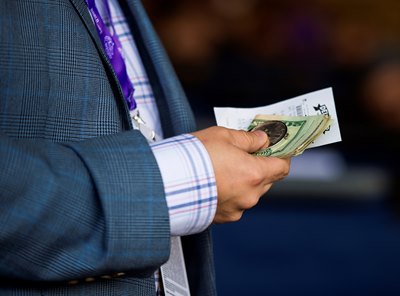
A bettor makes a wager during the Breeders' Cup at Del Mar
Wagering in the U.S. grew to more than $12.2 billion in 2021, an increase of nearly 11.9%, according to statistics released Jan. 5 by Equibase. That monetary figure includes worldwide commingled wagering on domestic races.
Purses also increased, as did race days, races, and starts, though the rise of the latter three numbers was in large part related to the shortened racing seasons in many jurisdictions in 2020 with the onset of COVID-19. Race days, races, and starts dropped compared to pre-COVID-19 figures from 2019.
Relative to 2019, wagering was up more than 10.7% and purses were up 1.1%. In a concentrated market with less racing last year, average purses per race day rose 10.1% from 2020 and 9.9% when compared to 2019.
"Against an extraordinarily difficult backdrop, the resiliency of Thoroughbred racing was on full display in 2021 as we concluded the year with significant growth in purses and total handle of more than $12 billion, the highest since 2009," Tom Rooney, president and CEO of the National Thoroughbred Racing Association, said in a distributed statement. "We thank our customers for their ongoing support as their wagering dollars continue to fuel our industry. As we turn the page to 2022, we look forward to the beginning of a new era for U.S. Thoroughbred racing with the launch of the Horseracing Integrity and Safety Act and an even greater focus on equine safety and welfare and the integrity of America's oldest sport."
Despite reductions in racing, field size continues to decline. Average field size was 7.37 horses per race in 2021, below the 7.94 average from 2020 and 7.53 mark in 2019. Field size in 2020 rose sharply after racing resumed in many areas after a spring COVID-19-related shutdown.
This past year brought a return of fans to many racetracks after tracks initially reopened in 2020 with spectatorless racing under COVID-19 health protocols. Equibase does not track attendance in its year-end report, nor on-track handle.
In general, wagering via advance deposit wagering platforms has been the key growth segment in U.S. wagering, with more bettors playing racing from computers and mobile devices.
|
Thoroughbred Racing Economic Indicators |
|||
|
YTD 2021 vs. YTD 2020 |
|||
|
Indicator |
YTD 2021 |
YTD 2020 |
% Change |
|
Wagering on U.S. Races* |
$12,218,407,637 |
$10,922,936,290 |
+11.86% |
|
U.S. Purses |
$1,180,853,677 |
$869,771,206 |
+35.77% |
|
U.S. Race Days |
4,072 |
3,302 |
+23.32% |
|
U.S. Races |
33,567 |
27,700 |
+21.18% |
|
U.S. Starts |
247,416 |
220,006 |
+12.46% |
|
Average Field Size |
7.37 |
7.94 |
-7.20% |
|
Average Wagering Per Race Day |
$3,000,591 |
$3,307,976 |
-9.29% |
|
Average Purses Per Race Day |
$289,994 |
$263,407 |
+10.09% |
| 2019 Comparisons | |||
| YTD 2021 vs. YTD 2019 | |||
|
Indicator |
YTD 2021 |
YTD 2019 |
% Change |
|
Wagering on U.S. Races* |
$12,218,407,637 |
$11,033,824,363 |
+10.74% |
|
U.S. Purses |
$1,180,853,677 |
$1,167,920,667 |
+1.11% |
|
U.S. Race Days |
4,072 |
4,425 |
-7.98% |
|
U.S. Races |
33,567 |
36,207 |
-7.29% |
|
U.S. Starts |
247,416 |
272,553 |
-9.22% |
|
Average Field Size |
7.37 |
7.53 |
-2.08% |
|
Average Wagering Per Race Day |
$3,000,591 |
$2,493,520 |
+20.34% |
|
Average Purses Per Race Day |
$289,994 |
$263,937 |
+9.87% |
| * Includes worldwide commingled wagering on U.S. races. | |||