
$1M Pink Bonus to be Offered by Inglis Race Series
Image:
Description:
Photo: Mark Gatt
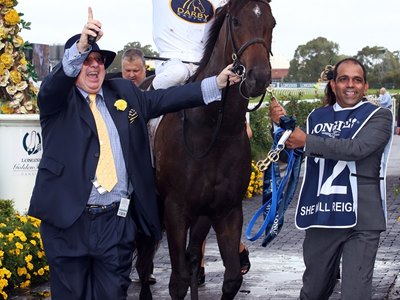
Inglis Sale graduate She Will Reign after her win in the 2017 Golden Slipper Stakes at Rosehill Gardens
Inglis will significantly ramp up its pitch to female racehorse owners as well as boost prize money for its already lucrative sales-restricted races in a sign it is actively engaging its Australian auction house rival Magic Millions in an apparent incentive scheme arms race.
Inglis has announced a massive overhaul to the prize money structure for five of the company's signature sales-restricted races—headlined by the introduction of an AU$1 million 'Pink Bonus' targeting horses majority-owned by women—in a move which further demonstrates the fierce competitiveness of the Australian bloodstock market.
Under the revamp, an additional AU$1.55 million will be up for grabs for horses who are entered in the Inglis Race Series from the beginning of next season, taking the prize money pool for 2022 graduates to AU$7.55 million.
The Pink Bonus is similar to the highly successful AU$500,000 Magic Millions women's bonus for its 2-Year-Old Classic and the AU$250,000 purse for its 3-Year-Old Guineas races, but instead of the money being split between the owners of multiple horses, it will be a 'winner takes all' scenario for the Inglis initiative.
From the 2022-23 racing season, a Pink Bonus of AU$400,000 will be awarded to the first eligible horse home in the Inglis Millennium and AU$200,000 in the Inglis Sprint, the Inglis Banner, and the Inglis Nursery.
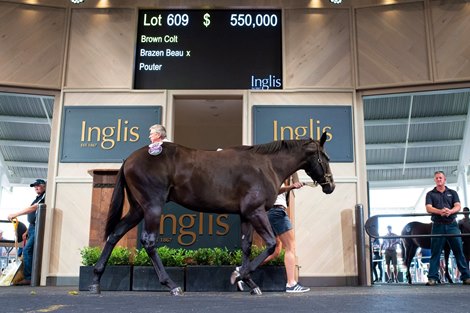 A yearling in the ring at the Inglis Classic Yearling Sale
A horse must be at least 75% owned by women to be eligible for the Pink Bonus and the changes will come into effect for horses born in 2020 that are purchased through an Inglis auction, starting with next weekend's Classic Yearling Sale.
Inglis Bloodstock chief executive Sebastian Hutch on Jan. 30 made no secret of the fact female owners had become a major segment of buyers in the yearling market, and he praised Magic Millions for its own "fantastic initiative and one that we've admired."
"We have taken a patient approach in assessing what we feel would be the most effective step and, clearly, particularly through the pandemic, it has been evident that the volume of people interested in participating in racing is growing," Hutch told ANZ Bloodstock News.
"Certainly the fact that the show (racing) has stayed on the road during the pandemic and now we have wall-to-wall free-to-air coverage of racing has been very positive features in achieving that, and the female ownership base is an important part of that.
"Twelve of the runners in the Millennium in 2021 had female owners involved and I think that's indicative of a developing ownership base amongst the female population and that is something we want to try and embrace, consolidate, and grow."
 Sebastian Hutch, chief executive of Inglis Bloodstock
As well as the introduction of the Pink Bonus, the auction house has also returned the prize money purses to pre-pandemic levels for the Flemington-run Inglis Sprint, the Inglis Banner at Moonee Valley, and the Inglis Nursery, held at Randwick.
The Inglis Bracelet, which was run for the second time at Flemington on VRC Oaks day last November, will also have its prize money increased from AU$250,000 to AU$350,000.
The fourth running of the Millennium, for which Arrowfield Breeders' Plate (G3) and Inglis Rural Property Golden Gift winner Sejardan is the favorite, will take place at Randwick on Saturday.
"We like the fact that the opportunities are spread right throughout the year, at a variety of different tracks, and that appeals to people," Hutch said of the Inglis Race Series.
"The feedback that we get is that it is an important part of our race series and that it'll be something that we will be looking to maintain and further develop as time goes by."
The changes to the Inglis Race Series comes just three weeks after Magic Millions announced that, from next year, it would hold The Syndicate, a 3-year-old and upwards race worth AU$1 million for graduates owned by a minimum of 20 people, and an AU$500,000 The Debut for unraced juveniles on its AU$11.75 million January Gold Coast race day.
Hutch dismissed suggestions Inglis had to respond to Magic Millions' latest race day innovation, instead saying the advent of the Pink Bonus came after canvassing of clients for some time on how to improve its own race series.
"We've been focused for a long time on how we would look to develop this series, what additions we would make to it and we have felt, after careful consideration, this was an appropriate step to take," he said.
"We race in a country where the prize money returns to owners are well in excess of AU$800 million, so there's massive prize money independent of the incentives we or anybody else may offer.
"By the same token, we have a mandate to try to develop the ownership pool and we feel this is an appropriate step that can make a contribution towards doing that."
Hutch believes the healthy competition in the Australian market is what helps generate not only enormous domestic demand for bloodstock but also immense international interest.
"Other jurisdictions around the world look at what happens here with genuine envy," he said. "We are fortunate enough that we've had a number of international visitors looking to participate in our sales as buyers but, similarly, there's an ever-increasing number who are participating as sellers as well.
"You take someone like John and Carolyn Warren (of Highclere Stud), who have a very successful breeding business in Britain. John is part of a Golden Slipper (G1) favorite, Coolangatta, whose dam went through an Easter Yearling Sale and a significant part of his business is his breeding business in Australia.
"I think it's a tremendous compliment to the market here that so many international people want to get involved in it. It's demonstrative of the fact that the market is so well serviced here by the auction houses and by the other various providers."
The timing of the improvements to the Inglis Race Series, which in the past has produced Longines Golden Slipper winner She Will Reign, Wild Ruler, Nature Strip , and Extreme Choice, will generate more interest in the company's opening auction of the 2022 season, the Classic Yearling Sale, which begins at the Riverside Stables complex on Sunday, Feb. 6.