At Conference, Horsemen Outline Concerns With HISA
Image:
Description:
Photo: Denis Blake/HBPA
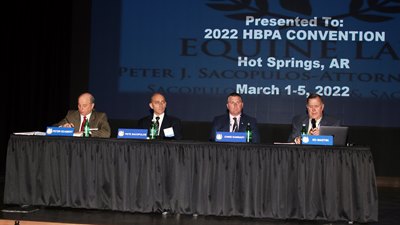
(L-R): National HBPA general counsel Peter Ecabert hosts panelists Pete Sacopulos, Chris Kannady, and Ed Martin during the National HBPA Conference
During a panel discussion on the Horseracing Integrity and Safety Authority at the National Horsemen's Benevolent and Protective Association conference, National HBPA CEO Eric Hamelback outlined concerns about the authority that will be tasked with overseeing the sport's safety, drug testing, and anti-doping on a national level.
The topic was covered by the second panel on the conference's opening day of discussions March 2 at the Oaklawn Park hotel in Hot Springs, Ark. Panel discussions are scheduled to continue at the conference through Friday with a full HBPA board meeting scheduled March 5.
The National HBPA and many of its state-level groups have filed a lawsuit against HISA in federal court—the Northern District of Texas. Hamelback said Wednesday that the HBPA wouldn't necessarily oppose federal legislation to help the sport but he has concerns about the legality of HISA, a board that will operate under the Federal Trade Commission.
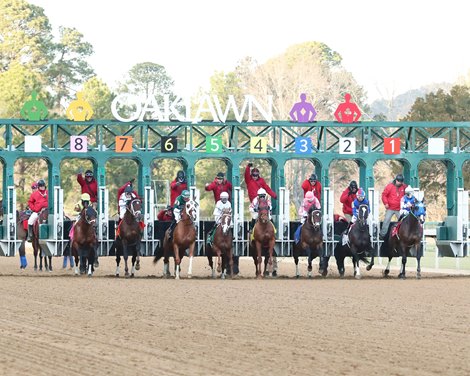
 The National HBPA Convention is being conducted at Oaklawn Park
"Is it legal or is it illegal? I've maintained from the very beginning that I don't have any problem—nobody in the HBPA has any problem—with national uniformity based on science," Hamelback said. "Do we have a problem with something that is illegal? Hell yeah we do. The purpose of this lawsuit, if nothing else, is for people to understand that.
"I feel passionately about finding out if this is legal or not legal," Hamelback added. "If all the sudden HISA was in play and we have some of the scandals that are in the industry now, and they get some high-powered lawyers and prove that (HISA) is unconstitutional or illegal; at that point, they walk away scot-free. So we have to do our due diligence now as a horseman's representative to make sure this is legal."
Panelist Pete Sacopulos, an attorney who submitted an amicus brief on behalf of the North American Association of Racetrack Veterinarians supporting the HBPA lawsuit, outlined four legal concerns about the legislation during Wednesday's panel discussion.
Sacopulos said there are standards in place that prohibit Congress from having a private entity making laws, and he added that there also are concerns about how the members of the authority were appointed. He said there also are rules that prevent the federal government from coming in and taking over state-run entities.
The fourth item of concern outlined by Sacopulos was due process. He noted that currently appeals of stewards' rulings typically go to hearing officers and full commissions at the regulatory level and then to state circuit courts if legal appeal is pursued. He said that under HISA, appeals would be heard at the federal level—on the regulatory side and on the court side. He said this is a more expensive process and could require long travel to have an appeal considered.
He believes those are some of the reasons HISA doesn't meet the due process standard.
"That appeals process is going to be very, very different for participants," Sacopulos said. "It's something that all of you should take note of because it will be a major, major league departure from where we have been. ... Because due process is the right to be heard in a meaningful way in a meaningful time and this creates a cost barrier that most people simply can't pay. From my clients' standpoint, this is problematic."
HISA, of course, is arguing in court that its setup is constitutional. HISA supporters have argued that the authority is constitutional and able to make rules as it is subject to review by the Federal Trade Commission, which also can consider appeals of any sanction for a rule violation.
In a February hearing in the Texas case, HISA supporters said any claim that HISA violates due process considerations by empowering industry actors to regulate their competitors involves "multiple layers of conjectural, improbable, and unexplained acts of bad faith, for which (plaintiffs) offer no evidence."
Wednesday's panel also included Association of Horse Racing Commissioners International president Ed Martin, who raised concerns about the transparency in the authority's process and said it's lack of communication with state regulators has created a great deal of uncertainty. The ARCI is an umbrella group that passes model rules it encourages its members—state racing regulators—to adopt.
"The most important thing states need right now is certainty," Martin said, noting that states need to create budgets and understand new responsibilities. HISA plans to begin oversight of safety issues in the sport July 1 but has pushed back its date to launch oversight of drug testing and anti-doping to early 2023. Martin said the uncertain timing potentially could be disruptive but noted that state regulators will do their best to keep any transition smooth.
"We're going to be cooperative to try to avoid the mess," Martin said.
Sacopulos speculated that no matter how the Texas case turns out, there likely will be an appeal. He anticipates such an appeal resulting in a delay in HISA's launch—at least in the areas of contention in the appeal—while that court makes a decision.
If that becomes reality, Hamelback believes it could provide an opportunity for further discussion.
"It's kind of my personal hope that there will be a court ruling that forces everyone to reassess what they're trying to do," Hamelback said. "We all want the same thing: safe horses, honest races, a healthy sport."
In the day's first panel, Terri Hoffrogge, horsemen's bookkeeper at Oaklawn, and Kristie Piglia, bookkeeper for the Louisiana HBPA, encouraged owners, trainers, and jockeys to move to ACH transactions as opposed to checks. They said these direct-deposit type transactions improve security and allow for speedy payments for horsemen, especially for horsemen on the move from track to track.
"It's a good way to go," Hoffrogge said, adding that most participants have made the transition. "We've tried to get a lot of owners, trainers, jockeys on it. We can send the money directly to the bank and it gets there the next day. We write a lot fewer checks now. I think it's safer doing it this way."
Hoffrogge said horsemen visiting Oaklawn may not have their bank in town. She said ACH deposits allow money to easily go to the out-of-town bank. She said while they still do issue checks—and some horsemen prefer that payment—it is a process more susceptible to theft or having checks lost in the mail. She noted ACH also creates a record of each deposit that horsemen can scan, a process that can help reveal any problems or fraud.
A conference participant noted that their track does not offer ACH deposits. Piglia said the bookkeeper should work with their financial institution to set it up, noting it's typically an easy process.