
Lazarus, Guilfoil Discuss HISA With KY Farm Managers
Image:
Description:
Photo: Byron King
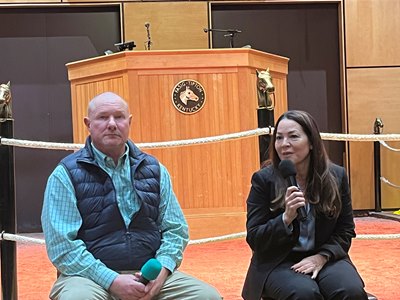
HISA executives Marc Guilfoil and Lisa Lazarus speak in the Fasig-Tipton sales pavilion
Equines weren't the only ones to command an audience in the Fasig-Tipton Sales pavilion Oct. 25.
Following the conclusion of the second day of the Kentucky October Yearlings Sale on Tuesday, Lisa Lazarus, CEO of the Horseracing Integrity and Safety Authority, participated in a question and answer session during the October meeting of the Kentucky Farm Managers Club. The KTFMC and the Kentucky Thoroughbred Association welcomed Lazarus to the EquiTrace-sponsored event.
The federal HISA program is now responsible for drafting and enforcing uniform safety and integrity rules in U.S. Thoroughbred racing, having begun its Racetrack Safety Program in July. Its Anti-Doping and Medication Control Program is set to take effect in January.
Lazarus' appearance before a group of about 100 individuals largely involved a discussion of issues facing farm managers, horsemen, and owners. Topics ranged from registration of horses, licensing, search and seizure questions, riding crop rules, voided claim rules, allowed and prohibited medications, and testing for those medications.
Those medications have recently been released on the HISA website, Lazarus said, with distinctions made between controlled and permitted medications.
"They should be treated very differently—not only should the racing (industry) know that, but the public should know that," Lazarus said.
Under the ADMC Program, controlled medications are regulated by detection time, not withdrawal times, which had been the industry norm. Many medications will be regulated by limit of detection.
Marc Guilfoil, HISA director of state racing commission relations, also joined in the Q&A session with Logan Payne, president of the KTFMC.
Guilfoil emphasized he believes uniformity of drug testing under the HISA program will reduce confusion for trainers and periodic positives triggered by horses transferring between states. The participating laboratories will follow the same protocols and testing procedures, Guilfoil and Lazarus said.
Toward the end of the hour-long session, Lazarus was asked to address a key question: How will it pay for itself? HISA announced last week that it would seek a total of $72.5 million for its first year of full operations in 2023, with about three-quarters of that assigned to the ADMC program.
If state racing commissions do not opt into supporting HISA and accepting responsibility for paying the assessments, the fees will be assessed to the state's racetracks.
One audience speaker, National Horsemen's Benevolent and Protective Association CEO Eric Hamelback, cautioned those in attendance of the need to understand the significance of being a responsible person for an equine under HISA rules, and the potential problems that could unfold when a horse travels outside a racetrack.
He also raised concerns about HISA fees falling on racetracks to pay, mentioning that some tracks could have multi-million-dollar assessments. "Where's that going to come from?" he asked.
Lazarus defended the hefty cost of the HISA program following an earlier question from a member of the audience, saying she believes utilizing existing testing infrastructure will reduce expenses to a degree.
"Probably the best way for me to explain this is to say that there's already a lot of money that's being spent on anti-doping in this country, but not nationally, maybe not as efficient as it could be under one national program," she said. "And the only way that we make this affordable for the industry is being able to hold on to that."
Despite critique by some organizations and states that HISA creates bureaucratic red tape and additional costs without substantive policy changes, she views HISA as an investment worth making.
"Everyone can do their thing and be successful and thrive and prosper because they have this foundation that's protecting the reputation, the integrity, and safety," she said.