
Sam Houston to Begin 2023 Meet Without Simulcast Export
Image:
Description:
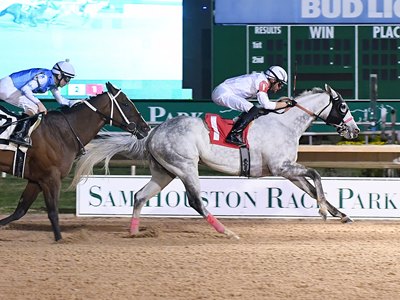
Photo: Coady Photography
Racing at Sam Houston Race Park
When Sam Houston Race Park opens for its 2023 Thoroughbred season Jan. 6, it will be without the out-of-state export of its simulcast signal amid continued opposition of the Horseracing Integrity and Safety Authority by the Texas Racing Commission and other entities in Texas. The track can still send out its signal within the state of Texas and internationally to a racetrack such as Woodbine in Canada.
HISA, authorized in 2020 federal legislation, began its initial responsibilities for drafting and enforcing uniform safety and integrity rules in U.S. Thoroughbred racing last summer.
In a Jan. 4 notice to licensees, Amy Cook, executive director of the TRC, wrote, "The best path forward for Texas horseracing continues to be the denial of HISA's jurisdiction to allow our state's industry to move forward and operate in an atmosphere of regulatory certainty. Accordingly, all requests to approve the interstate export of Thoroughbred pari-mutuel simulcast signals will continue to be denied until such time as all constitutional defects of the HISA statute are resolved and Texas law is conformed to harmonize with the federal legislation."
The policy is in keeping with procedures in place in Texas at Lone Star Park that began in July when HISA's Racetrack Safety Program launched. Lone Star Park raced through its meet's conclusion July 24 without simulcast export. Handle plummeted, with exotic wagers having such limited pools that they sometimes returned consolation payoffs because no bettors held winning tickets to all the races in the sequence.

Dwight Berube, vice president and general manager at Sam Houston, acknowledged that could also occur at Sam Houston, which has not altered its wagering menu.
"For all races, the pools will be smaller than what we've seen in the past years," he said. "So, sure, we're gonna run into situations where there will be carryovers or payouts of two-out-of-three (for example, in a pick 3), in accordance with the rules of racing in Texas."
He expressed the Texas track's support of its commission.
"We're hopeful this can get resolved in the near future, whether that happens soon enough to impact the current Thoroughbred meet is looking more doubtful by the day, but you never know what could happen," he said.
Full meets of Thoroughbred racing have not taken place in Texas since the Lone Star meet ended last summer. HISA does not oversee Quarter Horse racing, which also is offered in Texas.
In her Jan. 4 notice, Cook wrote the late December passage of the omnibus bill known as H.R. 2617, which, among many financial-related items, contained language remedying a constitutional defect identified by the Fifth Circuit U.S. Court of Appeals "did not resolve the statutory conflict between HISA and the Texas Racing Act."
According to Cook, although HISA has an admirable goal, its federal oversight creates a statutory conflict that "threatens to prevent the Texas Racing Commission from fulfilling its regulatory duties on pari-mutuel wagering."
Cook added that "each state must opt into HISA for preemption to go into effect, or HISA must assert jurisdiction based on the Interstate Horseracing Act of 1978 (the basis for interstate simulcast export)."
According to HISA CEO Lisa Lazarus, if the TRC chooses not to allow racetracks to export their signal, they do not fall under HISA's authority. She disputes the TRC's interpretation of the Texas racing law.
"We think the law is extremely clear that given there is now federal law, that federal law preempts (state law)," she said. "That's been a view that essentially every other racing commission has accepted. We respect Texas' decision, and we just hope that in the future things change and we are able to work together."
Seventy horses, plus five also-eligibles, are part of the opening-day program at Sam Houston, where purses for maiden and allowance runners are in the $35,000-$37,000 range, roughly equivalent to what they have been in the past.
In expectation of the restrictions in simulcasting, the track trimmed its season from 50 to 43 days and eliminated some stakes races, including a pair of races from its Houston Racing Festival. Entire purses dropped from $12 million in 2022 to $10 million this year.
 Pauline's Pearl wins the 2022 Houston Ladies Classic Stakes
Texas purses are less dependent on betting than other states after the state passed legislation in 2019 that directs part of the money from sales tax on feed, tack, and horse products toward an account that funds purses. It is responsible for funding roughly half of the $10 million in available purses this meet.
"It's hugely, hugely important to us," Berube said.
Sam Houston, which opened in 1994, has a stakes schedule headlined by its Houston Racing Festival, with five stakes races worth over $800,000 in purses taking place Jan. 28. Two of those stakes are graded: the $300,000 Houston Ladies Classic (G3) and the $200,000 John B. Connally Turf Cup (G3T). Two years ago, St. George Stable's eventual champion Letruska successfully launched her season in the Ladies Classic. Other notable Houston Ladies Classic winners include Forever Unbridled and Midnight Bisou .
The Thoroughbred season continues through April 8, with afternoon racing on Fridays, Saturdays, and Sundays at 1 p.m. CT. Holiday Monday racing, also at 1 pm, will take place on Martin Luther King Day and President's Day.
Horsemen and fans from outside Texas wishing to watch live racing or replays from Sam Houston can continue to do so on the track's website, Berube said.
Track management felt that racing Fridays and weekends provided the best opportunity to appeal to on-track attendees, who it will seek to target with a series of promotions and events, beginning with an ownership seminar Jan. 7.
In previous years, Sam Houston ran during earlier portions of the week and sometimes at night to capitalize on off-track handle. But for this meet, the on-track customer becomes an even more vital focus, much like the era before widespread simulcasting began.
"I feel like I'm back in the '70s," Berube quipped.