
Baffert Takes Stand in Preliminary Injunction Hearing
Image:
Description:
Photo: Anne M. Eberhardt
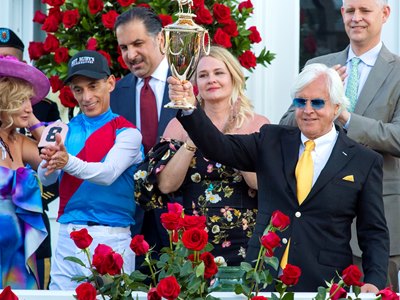
Trainer Bob Baffert (dark suit) holds a trophy aloft after Medina Spirit's first-place finish in the 2021 Kentucky Derby at Churchill Downs
Testifying in a Louisville, Ky., courtroom Feb. 3 that "I'll probably lose another half" of his top 3-year-olds, Hall of Fame trainer Bob Baffert stated his case for legal relief in his bid to end a two-year ban instituted by Churchill Downs Inc. The CDI action came after Baffert's trainee, Zedan Racing Stables' Medina Spirit , tested positive for the anti-inflammatory betamethasone after crossing the wire first in the 2021 Kentucky Derby (G1).
Baffert's attorneys have requested a preliminary injunction that, if approved by U.S. District Court Judge Rebecca Grady Jennings, could allow the Baffert to compete in the May 6 Kentucky Derby and other major races staged by Churchill Downs this spring. Without such legal relief in Baffert's ongoing suit with the track operator, CDI's prohibition of Baffert running horses at its tracks will last through the conclusion of the Churchill Downs spring meet that wraps up in early July.
Jennings did not issue a ruling Friday and was vague in announcing when one would be forthcoming, only saying it would come within "the next period of time." Also in front of her is a motion to dismiss the lawsuit.
Two chief considerations for Jennings to weigh in determining whether to grant or deny preliminary injunctive relief are whether Baffert has a likelihood of prevailing on the merits of his case and if he will sustain irreparable harm if relief is not granted. Attorneys for Baffert and CDI both took aim at the latter consideration Friday.
Orin Snyder, one of six lawyers in court Friday on behalf of CDI, initially questioned Baffert, hammering him for previously signing two affidavits saying that CDI's suspension would "effectively put him out of business," circumstances that never came to pass. Baffert's stable, according to Equibase records, won 75 races and more than $9.7 million in North America in 2022, plus more overseas, despite him missing part of the year while he served a 90-day suspension issued by regulator Kentucky Horse Racing Commission for the betamethasone positive related to Medina Spirit. Medina Spirit was also disqualified, a decision under appeal.
Baffert acknowledged under questioning that he still had experienced enormous success while noting that CDI's ban "did hurt me" and "I should have done much better (statistically)."
Owners of top 3-year-olds have continued to flock to the California-based trainer, who has all four starters in the Feb. 4 Robert B. Lewis Stakes (G3) at his home base of Santa Anita Park. He had 14 of the 16 nominees in the race.
 Bob Baffert talks to the media after his 3-year-old trainee Arabian Knight's victory in the Southwest Stakes at Oaklawn Park
Baffert attorney Clark Brewster did not shy away from how loaded Baffert's stable is, seemingly in an attempt to persuade Jennings that for the trainer to miss the Kentucky Derby, it would be, at least from their standpoint, a miscarriage of justice. He had the trainer read the names of his trainees from a Daily Racing Form chart of the 10 fastest 3-year-olds to race in 2023 based on Beyer Speed Figures. Baffert trains seven of them.
Baffert called the Kentucky Derby the "crown jewel" of Thoroughbred racing and his annual target for most of his clients, whose strategy is to buy young colts with the aim they can experience success in Triple Crown races and other prestigious events, then be worth staggering sums at stud. Asked how many times he has won the Derby, Baffert replied, "seven," a tally that counts Medina Spirit despite his current disqualification.
"I broke the record. I'm very proud of that," Baffert testified.
With six official victories, Baffert is currently tied for the Derby win record among trainers with the late Ben Jones. Baffert and Jones have each won the Triple Crown twice.
If Baffert is unsuccessful in receiving a preliminary injunction, his horses would need to move under the oversight of other trainers before the end of the month to earn qualifying points toward the May 6 race. Last year, two Baffert trainees, Messier and Taiba , qualified and raced unsuccessfully in the Derby after being sent into the stable of trainer Tim Yakteen.
They eventually returned to Baffert, though the trainer maintains that his stable was depleted with horses that stayed in other barns. Some of the horses moved over the second half of 2022 appeared to be those not of upper-stakes quality. Baffert's stable is geared around the highest caliber of horses and stakes races.
That emphasis means that his horses are drug tested more per start than other trainers, with some states, such as Kentucky, testing more in certain stakes races than other types of contests. Baffert also said that because regulators often test losing favorites, he further garners more tests. His horses are routinely favored due to the high quality of the horses that join his stable and his success rate.
In Snyder's questioning of Baffert, he sought to portray the trainer as not fulfilling his duties under the trainer responsibility rule, noting nine positive tests with therapeutic medications with his horses from 2016-20 and suggesting Baffert had a negative impact on the sport with his actions and by breaking promises. Synder noted Dr. Michael Hore of Hagyard Equine Medical Institute did not take on an advisory role for Baffert to ensure rule compliance, as Baffert said the veterinarian would in a statement issued in November 2020.
Baffert testified Friday that Hore "couldn't make it" that winter to examine his California stable due to COVID-19. Hore offered a similar explanation to BloodHorse in mid-May of 2021, shortly after Medina Spirit's positive drug test.
Snyder also questioned Baffert over his shifting story related to Medina Spirit's positive drug test announced on May 9, 2021, playing audio of a media interview in which the trainer took no accountability for the positive finding. A telephone conversation with stewards, taped unbeknownst to Baffert, was also played in court, in which Baffert called Kentucky a "cesspool."
"I was rambling," Baffert acknowledged, testifying that his "state of mind was off the charts."
On May 11, 2022, two days after the initial announcement of the drug positive—which Baffert said he was forced to make due to a leak of the test to the media—Baffert said Medina Spirit was treated for a skin condition with an anti-fungal ointment known as Otomax, which contains betamethasone valerate, leading to the test result.
Pointing to ambiguous language in Kentucky Horse Racing Commission rules, Baffert's attorneys contend that betamethasone valerate is not specifically prohibited by the KHRC, in contrast to betamethasone acetate, the type of betamethasone used in joint injections, the typical way horses receive the corticosteroid. That is disputed by the KHRC, which believes the route of administration is irrelevant.
Otomax, marketed to treat ear infections in dogs, is not approved by the Federal Drug Administration for use in horses, though horses can be treated off-label with it with veterinarian documentation and client consent. An image of the drug packaging was shown in court Friday with ingredients such as betamethasone valerate prominently displayed on the package.
According to California Horse Racing Board treatment documents, Baffert's California-based veterinarian Dr. Vince Baker prescribed Otomax on April 9, 2021, and on April 19, 2021, as Medina Spirit readied for a start in the Kentucky Derby on the first Saturday in May.
Baffert's legal team said Feb. 2 that they planned to call him to testify Friday, but Brewster told the judge they would not in the interest of time and wishing to focus upon legal questions related to their request for a preliminary injunction.
Baffert concluded his testimony Friday by recalling how in the midst of the post-Derby firestorm, he received a 10-minute telephone call from then-President Donald Trump, who he said told him to "keep his head up."
 Mike Anderson
The only other witness to testify Friday was Mike Anderson, president of Churchill Downs, who was among a handful of CDI employees, led by CEO Bill Carstanjen, that met to discuss the drug test and CDI's potential actions toward the trainer after Baffert's initial press conference in announcing the positive test. After consultation, Carstanjen ultimately made the decision to suspend Baffert—first indefinitely and later for a two-year period from CDI tracks—after a second test result confirmed the initial finding of betamethasone.
Under direct examination from Christine Demana, Anderson testified the sanctions were a consequence of that test finding and actions by Baffert, in which Anderson claimed the trainer showed a "lack of respect for the rules and regulations" based on multiple medication positives in recent years and his continued denials in the immediate media blitz following the bombshell test result. He noted that Churchill Downs has an obligation to protect the Kentucky Derby brand, which the positive test had tarnished. He also noted that Baffert trainee Gamine had been disqualified for betamethasone in 2020 in the Kentucky Oaks (G1), Churchill's second most prestigious race.
Under cross-examination, Brewster sought to portray the CDI decision as being made without consideration of all the facts, while further suggesting that some Churchill Downs employees are entwined with the state regulator. State entities have more responsibilities related to due process, which Baffert's legal team believes was not provided to the trainer. Churchill did not hold a hearing or offer an opportunity for the trainer's side to be heard.
Churchill Downs senior director of communications and media services Darren Rogers initially called Baffert with the indefinite suspension, and Anderson telephoned him later with the update of the two-year suspension, the track president testified.
Brewster asked Anderson if he had spoken to the stewards or involved veterinarians or examined documentation or a database to confirm or refute Baffert's position, to which Anderson continually replied, "No." He also asked him if he and the other CDI employees had examined in detail the transcripts and ultimate results of appeals of previous positive tests from Baffert trainees that Anderson said weighed in the Carstanjen-led CDI decision. He again said he had not.
He defended CDI's right to exclude and suspend individuals as a private business.
-Dick Downey also contributed to this story.