
NYRA Seeks to Persuade Legislators of $455M Bond Plan
Image:

Description:
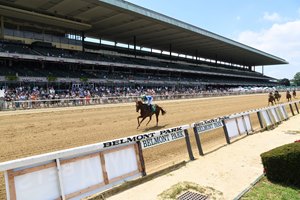
Photo: Coglianese Photos
Racing at Belmont Park
The New York Racing Association, seeking to tap into $455 million in state-backed bonds to finance the reconstruction of Belmont Park and eventually close Aqueduct Racetrack, on Feb. 9 publicly set its sights on a new, crucial audience: the New York State Legislature.
Having convinced New York Gov. Kathy Hochul to support the unusual borrowing plan—in which the state will issue bonds on behalf of a private corporation—NYRA and its allies now need to get the legislature, where the idea was killed last year, to okay the massive, 30-year bonding program.
NYRA president and CEO David O'Rourke was among a long list of people to appear Thursday before a joint budget hearing by the Assembly Ways and Means and Senate Finance committees. The overall topics of the day-long hearing were economic development and taxes, but O'Rourke, who sat next to a hearing witness sharply critical of the $455 million borrowing, focused all his testimony on the Belmont reconstruction proposal.
Among those O'Rourke has to convince are a number of skeptical lawmakers who last year halted the NYRA borrowing plan amid a series of concerns; lawmakers who stopped the plan from advancing last year include Sen. Liz Krueger, a Manhattan Democrat and the powerful chairwoman of the Senate Finance committee.
In her questioning of O'Rourke, Krueger did not specifically reveal her current position on the borrowing plan. But her opening line of questioning was direct: what happens if NYRA's franchise is not extended upon its scheduled expiration in 10 years and there are, under the bonding plan, still 20 years left for NYRA to repay the debt?
O'Rourke noted the Belmont property is owned by the state, and that would not change if NYRA loses its current franchise.
"We shouldn't have to sell the land to pay back your borrowing,'' Krueger said to O'Rourke.
The NYRA president told her the state-owned asset would "increase greatly" if the reconstruction project goes forward.
"But only if someone else wants to take up the horse racing franchise, right?" Krueger asked O'Rourke of the chance that NYRA might not still have the Thoroughbred franchise while the loan was not paid back to the state.
O'Rourke said the Belmont project is also creating "an incredible amount" of green space at the facility that would be a further valuable asset to the state. He also told Krueger that NYRA has gotten commitments that the Breeders' Cup will return to New York if Belmont is reconstructed.
 David O'Rourke
In lengthy written testimony submitted in advance of the hearing, O'Rourke presented lawmakers with the same laundry list of reasons the project should proceed that NYRA used with Hochul: the plan creates jobs, will not cost the state any direct money to fund it, and renovates a century-old track that has not seen major improvements since 1968 all while "securing the future of horse racing in the Empire State for years to come."
O'Rourke said the plan will benefit the state, which owns the racetracks and properties now leased to NYRA under a current 25-year exclusive franchise agreement, because it will greatly improve the appearance, operation, and value of Belmont Park as well as provide the path to close nearby Aqueduct and end what he called an "illogical, redundant situation" that sees downstate Thoroughbred racing shift between the tracks depending on the season. The borrowing would permit NYRA to turn Belmont into a year-round racetrack, with a new grandstand, luxury boxes, and tracks, along with the opening of the 45-acre infield to also allow big entertainment events at the Nassau County facility.
But the NYRA plan was opposed Thursday by groups representing government watchdogs to animal welfare organizations.
"Why is (New York) State loaning money for a brand-new luxury racing facility when the tracks they are replacing have atrocious attendance records?" John Scheib, a Saratoga County businessman with the Coalition to End Horse Racing Subsidies, said in written testimony to the two fiscal committees.
The group, whose members include People for the Ethical Treatment of Animals and an organization pressing for increased public education funding in the state, questions the fiscal logic of revenue-sharing proceeds that go to NYRA instead of the state government. Additionally, they note that NYRA's exclusive racetrack operating franchise is set to end in 10 years—20 years before the $455 million it is requesting in state-back bonding money is due to be fully repaid.
"What precedent exists in (New York) State history for loaning a half-billion dollars to a private business that has been shunned by banks and other lenders? If private funding won't back a new Belmont Park, (New York) State shouldn't either. Some of the wealthiest and most successful business executives in the world run their horses at NYRA's tracks; surely they can take this risk instead of (New York),'' Scheib noted in his written testimony.
The NYRA borrowing plan was also opposed Thursday by Reinvent Albany, a fiscal watchdog group, which urged lawmakers to "phase out illogical subsidies" to racing at NYRA tracks.
Critics say the monies NYRA receives from video lottery terminal proceeds at Aqueduct Racetrack should have long ago ended for both NYRA and others that rely on it, including purse accounts and breeding funds. As a result, they insist taxpayers will end up paying for the $455 million Belmont is borrowing because the repayment plan relies solely on the use of those video-lottery-terminal revenue-sharing payments to meet the principal and interest expenses over the next 30 years.
NYRA says its Belmont project can be completed in three years, after which NYRA agrees to end its lease on Aqueduct so that the valuable 100-acre property can be turned into some other economic development use.
O'Rourke told lawmakers that Belmont's aging condition has caused New York State the ability to host the Breeders' Cup and that the track is "outdated, not (Americans With Disabilities Act)-compliant, and lacks the modern amenities fans expect."
The NYRA president said the racing corporation has to rely on state borrowing instead of the private lending market because the not-for-profit corporation is "so intertwined with New York government and that our authorization to operate New York Thoroughbred racing is tethered to the government franchise." He pitched to lawmakers the idea that because the state owns Belmont Park, the borrowing plan "is tantamount to NYRA fixing up a taxpayer-owned asset at no cost to the state, while generating immense economic benefits."
O'Rourke also pledged to lawmakers that the Belmont construction project will use union workers and pay prevailing wage rates—a promise that will boost the effort's costs but would be a demand lawmakers would insist on, among other unknown items at this point, for any borrowing to go forward on NYRA's behalf.
"I strongly urge you to support this project,'' O'Rourke said, noting that the plan's backers include unions, business interests, and the racing community.
The state budget, which either will or won't include the NYRA bonding plan depending on how talks go between Hochul and lawmakers, is due by March 31.
The NYRA borrowing portion of the fiscal hearing came nearly five hours after the economic development hearing began. It lasted only about 25 minutes.
Unlike where lawmakers hear from panels composed of representatives of like-minded organizations, the NYRA panel saw O'Rourke and Scheib sitting next to each other at a table facing lawmakers in the legislative office building across the street from the Capitol.
Scheib blasted NYRA over equine safety issues and noted the decline in on-track attendance and tax receipts for New York over the decades. He said it would take NYRA, at current tax numbers, 83 years to pay the state in wagering taxes what mobile sports betting paid New York State in its first year of operation in 2022.
O'Rourke did not specifically address Scheib's points, except to say that the critic's comparison of today's horse racing industry to 1978 levels ignores the changes—notably to television exposure and off-track wagering—seen over the past couple generations.
Assemblywoman Carrie Woerner, a Democrat who represents Saratoga Springs, said she sees the impact of racing on a range of sectors in her district, from farming to tourism.
Woerner asked O'Rourke about the importance of continuing winter racing in downstate New York.
"It's extremely important, specifically to the breeding industry in New York,'' he said.
To have the continuity of year-round racing is "part of our core mission," he continued.
The NYRA plan calls for the racing corporation to re-pay the state $26 million from a portion of its VLT revenues derived chiefly from the Aqueduct Racetrack casino run by Resorts World. NYRA gets about $35 million annually in VLT revenue-sharing proceeds. O'Rourke said NYRA hopes to "accelerate" the repayment plan if the state goes ahead with the $455 million borrowing; he did not elaborate.