
Court Ruling Leaves CDI Suspension of Baffert In Place
Image:

Description:
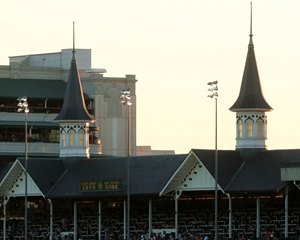
Photo: Coady Photography
Trainer Bob Baffert was dealt another litigation setback Feb. 17 when a federal court judge in Louisville, Ky., turned down a request for a preliminary injunction the trainer filed against Churchill Downs Inc., its CEO, and board chairman.
If the injunction had been granted, it could have cleared a path for the Racing Hall of Fame trainer to participate in this year's Kentucky Derby (G1). If this ruling stands up to any appeal, Baffert would miss a second straight Derby.
The Feb. 17 ruling by Judge Rebecca Grady Jennings of the U.S. District Court for the Western District of Kentucky denied Baffert's motion to enjoin the parent company of the Kentucky Derby from suspending his privileges at any Churchill Downs Inc.-owned track and dismissed all but one count of Baffert's underlying lawsuit. The likelihood that Baffert's attorneys could obtain timely relief from the order in the Sixth Circuit Court of Appeals remains to be seen.
"Churchill Downs is pleased that the court denied Mr. Baffert’s demand for a preliminary injunction and granted our motion to dismiss on all but one claim, and on that claim the court held that Mr. Baffert did not establish a likelihood of success on the merits," said a statement issued by CDI. "Today’s opinion is a victory for the integrity of horse racing and we will continue to take action to protect the safety of our human and equine athletes."
Clark Brewster, who represents Baffert in the lawsuit, did not immediately respond to a request for comment.
Baffert initially was suspended indefinitely from entering horses at Churchill Downs May 9, 2021 after Kentucky Derby winner Medina Spirit tested positive for betamethasone, a substance prohibited on race day in Kentucky. After testing of a split sample confirmed the initial test finding, Churchill Downs suspended Baffert, or any trainer directly or indirectly employed by Bob Baffert Racing Stables, from entering horses in races or applying for stall occupancy at all CDI-owned tracks through the end of Churchill's 2023 spring meet (July 3).
Besides the action by CDI, last year Baffert served a 90-day regulatory suspension issued by Kentucky stewards that kept him out of the Derby and the other two Triple Crown races.
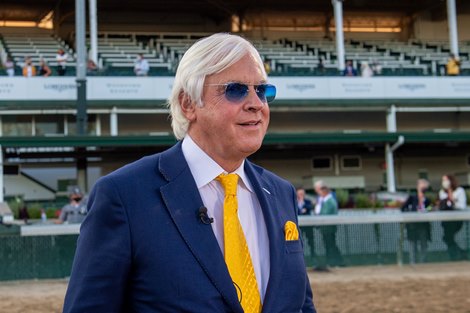 Bob Baffert at Churchill Downs in 2020
After the CDI suspension simmered for about nine months, Baffert sued the company, CEO William Carstanjen, and board chairman Alex Rankin, seeking a preliminary injunction to require CDI to allow Baffert and his stable of contenders to compete for 2022 Kentucky Derby qualifying points and entry into the Run for the Roses. The motion was dropped after stewards ruled against Baffert on the Medina Spirit drug positive and issued the 90-day suspension. Baffert was unable to persuade the Kentucky Horse Racing Commission, a Kentucky circuit court, or the Kentucky Court of Appeals to order a stay of that regulatory suspension.
A motion to dismiss the Baffert federal lawsuit was fully briefed as of last summer, but the matter was dormant until Baffert renewed the preliminary injunction motion Dec. 15 in an effort to get into the mix for the 2023 Derby. Jennings denied that motion in the ruling issued Friday.
Also under consideration was a CDI motion to dismiss the entire lawsuit. Jennings granted that motion except as to one count—an allegation that by suspending Baffert without notice and a hearing, Churchill Downs violated a right to due process of law guaranteed by the federal Constitution. Jennings wrote in a 36-page order the due process rights claim should not be dismissed when taking all of Baffert's allegations as true, something that must be done when considering a motion to dismiss.
Before taking up the merits of Baffert's preliminary injunction request, Jennings examined whether it was brought after undue delay.
"Here, plaintiffs renewed their motion for a preliminary injunction approximately 10 months after filing the complaint. Plaintiffs explained that CDI's suspension began May 9, 2021. This means they waited approximately 19 months after the suspension to request injunctive relief from this court," wrote Jennings. "Accordingly...delay (in bringing the case before the court) weighs against a finding of irreparable harm from the outset of the court's analysis."
Jennings examined Baffert's claim that he would be irreparably harmed without the injunction and found "that plaintiffs' (claim of) loss of purses is speculative and does not result in irreparable harm." Jennings also rejected an argument that Baffert's alleged loss of goodwill constituted irreparable harm, writing "There is no indication that owners would not continue to use plaintiffs' services after the 2023 Kentucky Derby even if the court did not enjoin CDI's ban."
Without a finding of irreparable harm, the preliminary injunction could not be granted as a matter of law, but Jennings went on to conclude, as to the merits of Baffert's claim of a due process violation, it is "unlikely" Baffert could prove his suspension "was attributable to the state," meaning his substantive claim for denial of due process was unlikely to succeed anyway.
By rule adopted for this year's Kentucky Derby, horses under the care of a trainer suspended by CDI must be transferred to a new barn unrelated to the trainer's operation by Feb. 28 to become eligible for Derby qualifying points in prep races. The next moves will be on the backstretch, not the courtroom, if Jennings' order is not undone by an appellate court.
Baffert has conditioned six Kentucky Derby winners. Medina Spirit was the seventh until he was disqualified. That decision was appealed at the regulatory level, and following a hearing last August the case is under submission to a hearing officer for the Kentucky Horse Racing Commission. Oral argument in the case, which was tried before a different hearing officer who later recused himself, is scheduled for March 1.
Baffert attorney Brewster filed a motion Feb. 10 to recuse Jennings from the federal case, a week after a hearing on the preliminary injunction motion. By separate order Jennings denied the motion, writing it fails for several reasons: the motion was filed at the 11th hour based on information that had been publicly available for months; Baffert did not sign the affidavit that formed the basis of the motion, and Brewster did not sign a separate certificate that he filed the motion in good faith, both requirements of the law; and there were insufficient facts alleged that would lead a reasonable person to question Jennings' impartiality.
Correction: In an earlier version of this story, the date that Brewster filed a motion to recuse Jennings was incorrect.