
Redevelopment of Metro Racecouse Pushes Trainers Out
Image:
Description:
Photo: Courtesy of Morphettville Racecourse/Jem Lang
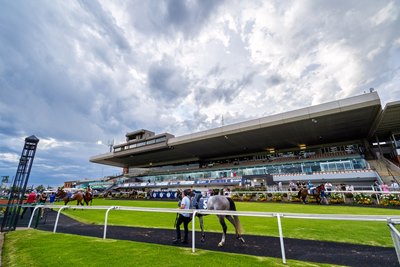
The paddock at Morphettville Racecourse
The long-term use of Morphettville as a training venue is under a cloud, but an AU$350 million redevelopment of Adelaide's metropolitan racecourse will provide financial certainty for the state's Thoroughbred industry, the South Australian Jockey Club says.
The revelation that there were no plans to add to the limited number of club-owned, on-course stables at Morphettville, Adelaide's sole metropolitan racecourse, came as the SAJC unveiled Villawood Properties and superannuation fund Hostplus as the joint venture partners to build an AU$350 million housing, retail, community, and commercial precinct.
Announced Feb. 27, the multipurpose site is to be constructed on a vacant 7.5-hectare parcel of land between Morphettville's home turn and the Anzac Highway, with works set to start late in the first, or early in the second, quarter of next year.
Key features of the project include:
- Mixed-use apartment buildings with more than 150 residences.
- A new community plaza linking Anzac Highway to Morphettville, which will be available for year-round events and create a grand entry to the racecourse.
- A supermarket, shops, hospitality outlets, a new SAJC-owned The Junction tavern, and SAJC offices.
- 250 townhouses and low-rise apartments ranging in height from two to three stories.
Demand for stables at Morphettville has outstripped supply in recent years, but SAJC chief executive Grant Mayer confirmed to ANZ Bloodstock News Feb. 27 that there was no plan for on-course stables to be constructed with the financial windfall from the "once-in-a-generation" development.
Mayer, who has guaranteed training will remain at the city track for at least the next five years, said the City of Marion Council was undertaking a rezoning process in and around the racecourse, which is separate from yesterday's announcement, that "shores up racing at Morphettville and strengthens our ties to the industry."
The SAJC chief executive indicated that trainers with off-course complexes might choose to cash in their properties to developers and then relocate to other venues, such as provincial tracks at Murray Bridge or Gawler, which Racing SA is investing in.
"My thought is, over the next five years, that trainers will, just as they have interstate, look at alternate locations," Mayer said.
"We are not doing anything to change that, but a development inside the racecourse is not something on the radar for us right now.
"We still train about 250 to 300 horses a day and we're comfortable where that is at. As I say, our point of view and our focus is working with Racing SA to find a solution for the growing needs (of trainers).
"Metropolitan Adelaide, like metropolitan Melbourne, is becoming harder for big training stables to exist in the metropolitan space.
"Right now, for the next five years, nothing is going to change, so I don't want anyone for a second to feel alarmed or concerned that this development is going to change that."
 Horses race past the grandstand at Morphettville Racecourse
Richard Jolly, who is in a partnership with his daughter Chantelle, is one such trainer who owns his stable complex adjacent to Morphettville racecourse.
South Australia's runaway premiership leader this season with 42 winners, Jolly said it "would be a very sad day if they stopped training at Morphettville."
"It is all right to say that we've got valuable assets, but we've still got to move somewhere and what if we don't want to move anywhere?" he told ANZ Bloodstock News.
"I'm also sitting on a house that we've been living in for 20 years and those (decisions are) all down the track, I suppose.
"I'd probably move on-course if they built stables, but it doesn't seem like they want to build them."
Initially, the SAJC had intended for the adjacent Magic Millions complex, which will host the 2023 Adelaide Yearling Sale March 14-15, to form part of the redevelopment of Morphettville, but offers made to buy the valuable landholding were rejected by owner Gerry Harvey.
"It was originally going to be a nine-hectare parcel of land, which included Gerry's. Gerry was very, very happy to be involved in a request for tender process and at the time when the offer came through, we sat down with Gerry over a nice Chinese meal; in the end for him, he wanted to stay put, and we respect that," Mayer revealed.
"To be fair, even the developer we've signed today, Villawood was absolutely mindful of and understood that Magic Millions would be in place.
"We believe the market that will be interested in the townhouses will be very much a racegoer market."
In 2018, the Melbourne Racing Club in conjunction with the state Labor government announced that Caulfield would no longer be a training center, with all its tenants moving elsewhere, principally to Cranbourne, Pakenham, and Ballarat.
Three years after being given notice, Colin Little was the last of 22 resident trainers to vacate the premises, two years ahead of the initial five-year schedule.
Ellerslie, Auckland's biggest racecourse, also sold off a parcel of land for redevelopment, with the income used to upgrade the racetrack and boost prize-money coffers, while the Brisbane Racing Club invested in in-field stables as off-site properties were redeveloped.
Jolly said over the years plans had been drawn up to build on-course stables, but they had never come to fruition.
"Where we train from in the mornings, they had designs put up there, and we went to meetings, and it all just got knocked on the head for whatever reason," the trainer said.
"They were saying things were dearer to build and costs of supplies went up, but they're still going to build a multi-million-dollar function center and all these (townhouse) buildings. If they can build them, they can build stables."
Mayer suggested the AU$350 million project was the most significant in the SAJC's history.
"By our constitution, we can't do anything but invest back in the club, so anything we get from this development is all about reinvesting back into training and racing," he said.
"This is the single biggest announcement in the 150 years of this club and what it does do is it absolutely underlines and ensures the future of racing at Morphettville and the industry in South Australia."
As Adelaide's last remaining metropolitan track—Cheltenham was sold for AU$85 million in 2007 and Victoria Park hosted its last race meeting in 2010—Morphettville's course proper and inside Parks circuit would require reinvestment as does the 45-year-old members' grandstand.
"There's new irrigation systems which are required to go through (the course proper), which is very expensive, and we've got to rebuild our maintenance facility for our staff (which) has been in place for many years, so it is a real opportunity to upgrade our facilities for our people and for the industry," Mayer said.
"The number one asset is our tracks and we want to make sure that we continue to maintain them the way they deserve to be."