
6th Circuit Appeals Court Declares HISA Constitutional
Image:
Description:
Photo: Dustin Orona Photography/Remington Park
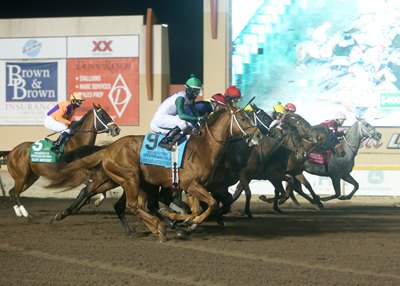
Racing in Oklahoma at Remington Park
In an opinion released on March 3 the U.S. Sixth Circuit Court of Appeals affirmed a lower court decision finding the Horseracing Integrity and Safety Act constitutional.
The case, which was filed against HISA and the Federal Trade Commission by the states of Oklahoma and West Virginia, their respective racing commissions, the Oklahoma Quarter Horse Racing Association and others, originated in U.S. District Court for the Eastern District of Kentucky. The district court also ruled in favor of HISA and the FTC.
The three-judge Sixth Circuit panel upholding that outcome was unanimous. Chief Judge Jeffrey S. Sutton delivered the opinion of the court in which Judge Richard Allen Griffin and Senior Judge R. Guy Cole Jr. joined. Cole delivered a separate concurring opinion differing slightly in how the issues were framed.
Procedurally, the appeals case was unusual in that a fundamental component of HISA was amended while the appeal was pending. The amendment, enacted by Congress and signed into law by President Joe Biden late last year, came on the heels of a Fifth Circuit Court of Appeals ruling that HISA was facially unconstitutional based on the delegation of too much power to HISA, a private corporation, and too little power to the FTC, an agency of the federal government. The change to the structure of the bill gives the FTC discretion to abrogate, add to, and modify any rules passed by HISA.
"Sometimes government works," wrote Sutton. "The Constitution anticipates, though it does not require, constructive exchanges between Congress and the federal courts. A productive dialogue occurred in this instance, and it ameliorated the concerns underlying the non-delegation challenge. As amended, the Horseracing Act gives the FTC the final say..."
"HISA is grateful to the Sixth Circuit for recognizing and affirming HISA's constitutionality," read a HISA statement issued after the ruling. "We remain focused on preparing for the launch of HISA's Anti-Doping and Medication Control (ADMC) Program on March 27 pending final approval by the FTC. Once launched, the combined ADMC and Racetrack Safety programs will, for the first time in racing's history, see national, uniform integrity and safety rules applied consistently to every Thoroughbred horse, racing participant, and racetrack in the country."
The decision creates a split of authority from the Fifth Circuit Court of Appeals opinion finding the statute facially unconstitutional, but because the two cases are in different stages procedurally, it's difficult to predict whether a showdown to settle the matter in the U.S. Supreme Court is inevitable. While the Sixth Circuit considered the congressional amendment to HISA, the Fifth Circuit ruling preceded the amendment. HISA and the FTC asked that court to reconsider its decision in light of the amendment, but instead, the matter was remanded, or sent back, to two federal district courts, where further proceedings are in the works.
Oklahoma and the other challengers to HISA presented separate arguments that the Act allows unlawful federal "commandeering," but the appeals court rejected them. Commandeering is unconstitutional and occurs when the federal government orders states to implement its laws.
The court ruled Oklahoma lacks standing to challenge a provision requiring state authorities to cooperate and share information with HISA. "Right or wrong about whether this requirement amounts to commandeering, Oklahoma and the other State plaintiffs lack standing to challenge it," Sutton wrote.
Another provision of the law says states may elect to collect fees from the industry and remit the money to HISA or states may refuse. If a state participates, it gains discretion over how the fees are collected. If a state refuses, the HISA collects the fees. This, wrote the court, is not commandeering.
Attorney Matthew D. McGill, who presented oral argument to the Court of Appeals for Oklahoma and other parties challenging HISA, said options to the adverse ruling are being considered.
"The HISA Act puts an unaccountable private corporation in charge of horse racing nationwide, and then requires that States pay for the privilege," McGill said in an emailed statement. "As (Supreme Court) Justice Alito recently explained, ‘[t]o ensure the Government remains accountable to the public, it cannot delegate regulatory authority to a private entity.’ That is just what HISA does. We are considering our options for further review."
Although not a party to the dispute in the Sixth Circuit, the National Horsemen's Benevolent and Protective Association and state affiliates were plaintiffs in the case decided in their favor by the Fifth Circuit. CEO Eric Hamelback said they are in it for the long haul.
"Today, we stand firmly on our victory in the Fifth Circuit; however we are disappointed in the Sixth Circuit ruling," Hamelback said in a statement. "We have stated from the onset that there are multiple aspects of unconstitutionality plaguing HISA. The Fifth Circuit ruled on the arguments presented to them, and the Sixth Circuit ruled on the arguments they were presented. With that, we remain confident in our arguments and committed to our case. As seen now, the shifting legal uncertainty only upholds more confusion ahead for the industry and should lead everyone to agree we need a new bill to correct this uncertainty. We will keep fighting all the way to the Supreme Court if necessary to protect our industry and make sure our rules and regulations are built on a legal foundation."
The National Thoroughbred Racing Association, which lobbied for the legislative fix to the law authorizing HISA, applauded the Sixth Circuit Court of Appeals decision.
"The decision today by the Sixth Circuit Court affirming the constitutionality of HISA is not only the right decision but the critical step we needed to move forward in the sport of Thoroughbred racing," NTRA President and CEO Tom Rooney said in a statement. "Later this month, HISA will begin the implementation of the Anti-Doping and Medication Control Program and will be fully functional. Now is a time for unity within the industry. HISA is the law of the land, and we must all come together to support its initiatives so that HISA can continue its mission to improve the sport with uniform standards of safety and fairness across the country."
Byron King also contributed to this story.