
Mild Winter a Boost to Belmont Construction
Image:
Description:
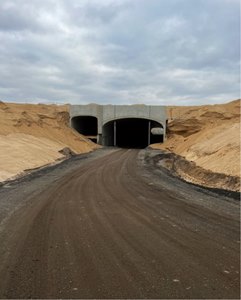
Photo: NYRA Photo
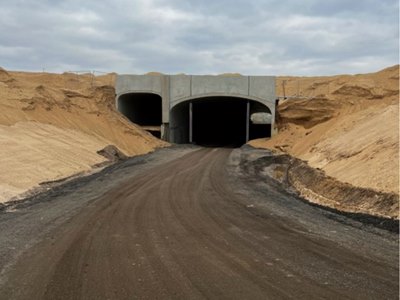
The new infield tunnel at Belmont Park
The unusually mild winter in the New York City area was a blessing for New York Racing Association officials, horsemen, and fans, yet no one has done as many cartwheels of joy about the weather as Glen Kozak.
As NYRA's executive vice president of operations and capital projects, Kozak is overseeing construction at Belmont Park which forced the shifting of its fall meet to Aqueduct Racetrack and, quite fortuitously, proceeded without any major delays during the coldest months of the year. In a Big Apple winter that featured a 328 days without snow and a minuscule total snowfall of 2.3 inches (the average is over 20 inches), the help from Mother Nature has allowed the first phase of the redevelopment of Belmont Park to remain on schedule, putting NYRA in position to have the 118-year-old track ready for its scheduled May 5 opening day and next weekend's anticipated start of training at the 1 1/2-mile oval.
"Without question, the weather cooperated with us, and most importantly, we were able to keep the track open for training until December like we normally do. The weather was very, very favorable and it has positioned us in a good spot," Kozak said about a winter with just two lost racing dates due to the weather after six in 2022. "Everything is nearly complete."
Pending approval of the New York State budget and a $455 million loan for NYRA, Belmont Park will be under construction for much of the next few years as NYRA moves forward with plans to consolidate downstate racing at the Elmont, N.Y., track and eventually close Aqueduct. NYRA has already announced the 2023 fall meet at Belmont Park will also be shifted to the Big A for a second phase that includes the addition of a second tunnel and a synthetic racing surface, as well as the widening of the inner turf course.
This past winter's work, which featured the construction of a pedestrian and automobile tunnel from the infield to the backstretch parking lot, was funded separately from the bond issue and was the important first step in advancing the project.
"This is the first step of a much broader process involving what's taking place with not just the surfaces but the infield and the facility. It puts us in a great position to move forward with updating all of the surfaces and installing the synthetic surface as well. We had excellent cooperation with the horsemen and the construction companies (Railroad Construction Corporation) did a great job to get us where we are," Kozak said. "We are in a good position because the lessons we learned with the first tunnel will help with the horse and pedestrian tunnels on the clubhouse side."
 Construction at Belmont Park
The construction of the tunnel called for digging up about a furlong-wide patch of ground on the backstretch near the three-quarters pole through the main track and the two turf courses to the infield. All of that work has been completed with the dirt and turf filled in so that racing can resume in its normal fashion. Kozak said Dr. Mick Peterson of the Racing Surfaces Testing Laboratories is expected to be at Belmont Park this coming week to test the surfaces and make sure they are even and safe for racing.
"The rails are up. We're waiting to install the outside rail on the main track and we have a little more honing of the base to do," Kozak said. "We got the turf down in December and got it blanketed and everything is still covered. The irrigation system is back in place. The rails are up on the two turf courses. The drainage has been installed. The marker on the three-quarter pole went back up on the main track and the surfaces are in good shape."
This winter's work also included the transformation of the west pond (on the grandstand portion of the track) from a decorative pool of water to a hub for the track's irrigation system once the turf courses have been revamped. Previously both infield ponds were only a few feet deep, but now the west pond is 14-feet deep and in the course of the next few weeks will be lined so that it can hold almost 15 million gallons of water.
"The west pond will have a pump station like we have at Aqueduct and Saratoga. It's basically modernizing the irrigation system. When it is installed, it will be a lot more efficient and a lot better for the health of the grass since we can get water down in the appropriate time frame," said Kozak, who added that NYRA will seek a permit to build a well for the pond. "At Saratoga we can turn on 48 heads (sprinklers) at one time while we can only do 16 or 18 at Belmont. The efficiency of watering the course properly is going to improve tremendously when it becomes operational."
Once Belmont's spring meet ends July 9, work on phase two of the project will commence in earnest. A second tunnel linking the frontside infield will be built in the area near the gap for horses entering the racetrack at the start of the clubhouse turn. This tunnel will eventually be the access that horses and riders use to reach the synthetic track.
If all goes well, the one-mile synthetic track should be ready for use when the 2024 spring meet begins. Kozak said visitors to Belmont Park will be able to see the outline for the synthetic track as well as piles of material for the new surface near the west pond. Work on setting the base for the new track has already begun in an area spanning the three-quarters pole to the quarter pole.
The synthetic course will be the inner-most of the four courses, built inside the 1 1/8-mile inner turf course, 1 1/4-mile Widener turf course, and 1 1/2-mile main dirt track that will retain its unique distance for the Belmont Stakes (G1).
The summer and fall will also be when work on the inner turf course begins with a widening of the final turn.
"We will be widening the inner, changing the irrigation, the drainage," Kozak said. "The courses were originally designed to be about 90 feet wide, but the turns were the pinch parts, especially the far turn. So, we'll be adding one running lane on the Widener and two on the inner.
"There's a lot to do in July, but thanks to the good winter weather we are in a position to hit the ground running."