
Florida HBPA Seeks Intervention in Decoupling Lawsuit
Image:
Description:
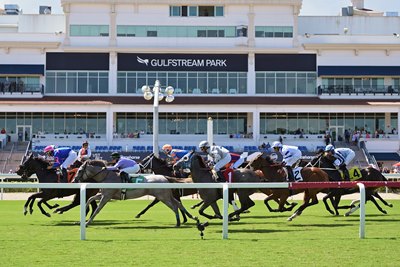
Photo: Coglianese Photos/Ryan Thompson
Racing at Gulfstream Park
Florida horsemen asked a court for the right to intervene in a lawsuit filed by Gulfstream Park seeking to decouple its horse racing business from its right to offer slot machine gambling.
The only defendant originally named in the litigation by Gulfstream Park is the Florida Gaming Control Commission, a regulatory agency providing oversight of all forms of authorized gambling in Florida except the state lottery. Groups that would be directly affected by the outcome of the case were not named as defendants.
A motion to intervene in the case was filed by the Florida Horsemen's Benevolent and Protective Association Oct. 1. The motion was recently added to the court's online docket.
The motion posits that the Florida HBPA is an indispensable party to the outcome of the case, entitled to intervene as a matter of right. It argues that Gulfstream Park has a duty set out by statute to maintain an agreement with the Florida HBPA in order to operate slot machines, and that the agreement in place requires the track to run races at least 80 days each calendar year.
"On behalf of the over 5,000 Thoroughbred horse owners and trainers who do business in Florida, the Florida Horsemen's Benevolent and Protective Association has filed a motion to intervene in the decoupling lawsuit filed by Gulfstream Park," said Florida HBPA president Tom Cannell. "Our organization has spent months proactively trying to work in good faith with Gulfstream Park to come to a consensual resolution. However, they have not been willing to discuss any specifics. Instead, Gulfstream continues to do anything possible to violate its agreement to never decouple through either litigation or legislation—a contractual agreement they made with us to never challenge the validity of the statute and a promise they made to Floridians who voted to authorize slot machines specifically for pari-mutuel facilities.
"Because Gulfstream has chosen to now breach this agreement through litigation, we have asked to intervene to protect the rights of horsemen throughout Florida and for the future of Thoroughbred racing in the state."
At the center of the controversy is a 2021 law relieving every Florida pari-mutuel operator except Thoroughbred tracks from the obligation to conduct a minimum number of live races or games as a condition of operating slot machines. The suit filed by Gulfstream Park seeks to have that law declared unconstitutional.
The track's central argument is that before 2021, all competitors were given the same right to operate slot machines so long as they ran live games or races. When Florida banned Greyhound racing in 2018, Gulfstream Park contends, the state allowed those operators to keep their slots licenses without offering pari-mutuel wagering and went on to memorialize that condition in the 2021 decoupling act.
The lawsuit was filed after a failed attempt by Gulfstream Park to attain decoupling through the Florida Legislature.
A Gulfstream Park release after it filed the suit says, "As part of the 2021 legislation harness tracks were given the option to retain live racing without implications for its slot machine license, while Gulfstream Park was singled out for irrational different treatment that not only required live racing but also carried significant penalties for not offering racing that included the loss of its slot machine license."
Lonny Powell, CEO of the Florida Thoroughbred Breeders' and Owners' Association, released a statement critical of the lawsuit shortly after it was filed.
"Gulfstream Park is one of the few entities in Florida authorized to operate slot machines—a privilege they obtained specifically from their involvement with Thoroughbred racing," Powell said. "This relationship has provided substantial economic benefits to the state for generations.
"The 2021 decoupling law was designed to preserve Florida's core horse racing institutions. Gulfstream Park's attempt to overturn it would open the floodgates, eroding Thoroughbred racing statewide, threatening family farms, rural jobs, and a multibillion-dollar agricultural economy."
A hearing on the Florida HBPA motion is scheduled Jan. 5. Should the motion be granted, the organization would have the right to proceed to its day in court with Gulfstream Park.