
NY Horsemen Predict Less Racing if Lasix Ban Expanded
Image:
Description:
Photo: Anne M. Eberhardt
New York trainers and owners indicated in a recent survey that they would be likely to participate in fewer races if the existing race-day ban on the anti-bleeding medication furosemide was extended to all races for horses 3-years-old and older.
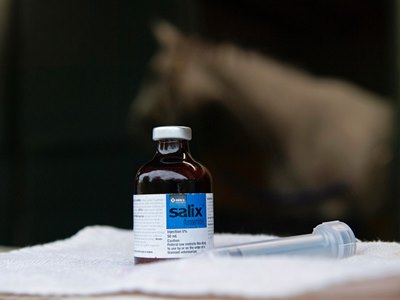
The New York Thoroughbred Horsemen's Association surveyed its members ahead of a vote in May by the Horseracing Integrity and Safety Authority board of directors regarding the future use of the medication commonly referred to by the brand names Lasix or Salix. Currently, the race-day use of furosemide is banned in all 2-year-old races and in the 48 hours ahead of a stakes race. Most states now operate under a three-year exemption for race-day use in all other races that will expire May 22.
Going back to 1974, Lasix has been used to eliminate or reduce the severity of exercise-induced pulmonary hemorrhaging. The federal legislation creating HISA calls for ban of race-day Lasix and a three-year study of that ban. States were allowed to apply for an exemption on overnight races for 3-year-olds and up while studies were conducted.
Three projects reviewed by HISA's Furosemide Advisory Committee were eventually selected and funded by HISA. The results of those studies were submitted by the end of January.
NYTHA found that if the race-day ban were extended to all races that 81% of horsemen surveyed said they would race less and that already 80% said they have bypassed a stakes race in favor of being able to use Lasix in an allowance/overnight race. NYTHA published the results of its survey in its Winter 2026 newsletter.
Regarding 2-year-old races, about 47% of NYTHA members surveyed said they had seen an increase in the number of EIPH incidences and an increase in the severity of bleeding episodes, while 27% said they had seen minimal or no bleeding at all, and another 27% reported seeing an increase in the number of episodes but not in the severity of the bleeding.
A slight majority of survey participants (38%) also reported that 10% or less of the horses in their stables had to be retired due to EIPH-associated conditions over the last three years, and 23% responded that they did not have any horses that had to be retired due to EIPH. Twenty-seven (19%) respondents said closer to 20% of their horses had to be retired, 17 (12%) said around 30% of their horses were retired, and 11 (7.7%) reported 50% or more had to be retired.
The NYTHA newsletter also includes several comments from members on their experience using Lasix and their position regarding the potential expansion of the ban. The comments are all anonymous but include references indicating they represent trainers, owners, and veterinarians.
See the full NYTHA survey results
The research projects recommended by Furosemide Advisory Committee and funded by HISA were the following:
- Furosemide Treatment and Racehorse Health and Welfare, a study to examine the effects of race-day furosemide treatment on the health and welfare of Thoroughbreds as well as their long-term racing performance. An analysis would be conducted to assess the association between pre-race furosemide administration and fatal injury, while also comparing the performance metrics—including lifetime earnings, career length, lifetime starts, starts per year, placings, and average speed figures—of horses that raced exclusively on furosemide as 2-year-olds and horses that did not receive furosemide for any races during their 2-year-old year.
- Effects of Repeated Furosemide Administration, a study examining the effects of repeated furosemide administration on electrolyte homeostasis, parathyroid response, and urinary electrolyte excretion in exercising adult Thoroughbreds. The study also examined the effects of repeated administration on bone density and strength using minimally invasive methods of measurement, including DEXA scan and OsteoProbe.
- Furosemide, EIPH, and Racing Careers, a study examining the impact of severe EIPH on horses' careers and the health of the racing industry more broadly. In doing so, the study will assess whether regular furosemide treatment is associated with more career starts and greater longevity, and look at the potential impact of banning furosemide for 2-year-olds on the duration of their careers and number of lifetime starts. The study also sought to determine the extent to which severe EIPH impacts the number of subsequent race starts, the periods between them and, when applicable, the time between the diagnosis of severe EIPH and retirement.