
HISA Board Keeps Current Lasix Standards in Place
Image:

Description:
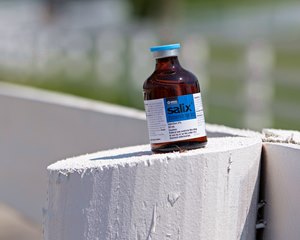
Photo: Anne M. Eberhardt
Perhaps the 50-plus-year debate in United States racing over the use of furosemide, commonly referred to as Lasix, has reached some level of a comfort zone as the Horseracing Integrity and Safety Authority issued a decision May 5 that keeps current standards in place.
The decision keeps in place rules that prohibit race-day use of the diuretic in 2-year-old races and stakes but allows its use in other races. Those rules are for HISA-regulated racing jurisdictions, which is most of the major racing states in the U.S.
Lasix supporters see it as the best method of preventing or reducing the severity of exercise-induced pulmonary hemorrhage during racing. Lasix opponents are concerned about integrity issues in racing and, eventually, breeding; as well as the side effects of the medication.
Read the May 5 release below
The Horseracing Integrity and Safety Authority board of directors today announced the results of its vote regarding the prohibition and use of furosemide (commonly referred to as "Lasix") in Covered Horses within the 48-hour period prior to a race.
Pursuant to the Horseracing Integrity and Safety Act of 2020, HISA's board was required to consider whether modification of the existing prohibition on furosemide was warranted. In accordance with the statutory framework, the board voted unanimously on April 24 to adopt findings required for a modification of the prohibition, which continues the existing regulatory status quo.
Under the Act, any modification required a unanimous board vote on the following four findings:
- That the modification is warranted.
- That the modification is in the best interest of horse racing.
- That furosemide has no performance-enhancing effect on individual horses.
- That public confidence in the integrity and safety of racing would not be adversely affected by the modification.
The board unanimously adopted each of these findings and approved a modification to permit the use of furosemide within 48 hours prior to a race for Covered Horses, with the exception of:
- 2-year-old Covered Horses; and
- Covered Horses competing in stakes races.
In reaching its decision, the board considered the findings and recommendations of the Furosemide Advisory Committee, which included a finding that available scientific evidence does not support the assertion that furosemide is a performance-enhancing substance.
While the modification will take effect May 23, 2026, it does not change the current regulatory treatment of furosemide that has been in place since the launch of HISA's Anti-Doping and Medication Control Program May 23, 2023. This means that furosemide administration in the 48 hours prior to a race will continue to be permitted for all Covered Horses except 2-year-old Covered Horses and Covered Horses competing in stakes races.
The HISA board's resolution and its findings, along with the FAC Report and scientific research reports, can be reviewed by clicking here.
Background
In 2024, HISA funded three scientific studies on furosemide use on horses during the 48-hour period before the start of a Covered Horse race, including its effects on equine health and the integrity of competition. The three projects selected for funding were approved by HISA's board of directors following a recommendation from HISA's Furosemide Advisory Committee.
Under the Horseracing Integrity and Safety Act, HISA is required to fund robust and rigorous scientific research on the topic of furosemide to inform the Furosemide Advisory Committee's recommendations to the HISA board on whether and how to amend HISA's existing furosemide regulations.
The HISA board approved $773,500 in grant funding for the studies to be conducted at Nationwide Children's Hospital, the University of Florida College of Veterinary Medicine, and Washington State University. The research submitted was then combined into a final report.
Under the federal law passed in late 2020, the nine-member HISA board was required to vote on future Lasix policy three years after the launch of HISA's Anti-Doping and Medication Control Program. The decision, to be based on the research studies it funded in 2024, faced a May 22 deadline.
At the launch of HISA, all of its jurisdictions requested and were granted an exemption from a full Lasix ban. That exemption saw the current Lasix regulation put in place in HISA jurisdictions that bans its use in all stakes and in races for 2-year-olds.
During an April 22 Q&A session at Laurel Park, HISA CEO Lisa Lazarus said the board had options: maintain the status quo, ban all race-day use, or loosen the regulation. Whatever decision is made, the vote must be unanimous under the law.
"There has been a lot of thought and discussion on the issue," Lazarus said. "The decision the board makes will be fair, balanced, and well-explained. I'm pleased with how seriously the issue has been taken. I really think the industry will be comfortable where the board lands (on the matter)."
 Horseracing Integrity and Safety Authority CEO Lisa Lazarus
HISA board member Joe DeFrancis, whose family previously owned the major Thoroughbred tracks in Maryland, said at the same April 22 session that the research was thorough.
"It is one of the best reports I've seen in my life," he said. "Everyone (on the board) is acutely aware that the industry needs to be able to function and operate."
Reaction
National Horsemen's Benevolent and Protective Association president Doug Daniels
"We appreciate the thoughtful and measured decision by the Horseracing Integrity and Safety Authority to reconsider the role of Lasix in race-day care. As the board approached its vote, it was clear that concern among horsemen and women was intensifying, rooted in the practical realities of managing equine health and welfare without a widely accepted therapeutic tool.
"Horsemen across the country are encouraged that the Authority acknowledged both the science and the lived experience of horsemen in concluding that furosemide is not supported as a performance-enhancing substance. This outcome reflects the importance of open dialogue and the willingness to listen to those on the ground who are directly responsible for the health and safety of the horse.
"Moving forward, we remain committed to working collaboratively to ensure that policy decisions continue to be guided by science, horsemanship, and the best interests of the horse."
Kentucky Horsemen's Benevolent and Protective Association president Dale Romans
"Kentucky HBPA commends the collaborative efforts of the Horseracing Integrity and Safety Authority, its advisory committees, and horsemen across the industry in reaching this thoughtful decision regarding furosemide. This outcome reflects a balanced, science-based approach that prioritizes the health and safety of our horses while maintaining the integrity of the sport.
"We appreciate the willingness of all parties to engage in meaningful dialogue and work together toward a solution that supports horsemen and strengthens public confidence in racing. It is through this kind of cooperation that our industry continues to move forward in a responsible and unified manner."
New York Thoroughbred Horsemen's Association
“The New York Thoroughbred Horsemen’s Association appreciates HISA’s decision to maintain the current Lasix rules. However, HISA must go further and permit 2-year-olds to receive Lasix. The elimination of Lasix for 2-year-olds to race could very well harm and cause irreparable damage to the horse. NYTHA believes New York-bred stakes races should also be allowed to use Lasix, since the elimination of Lasix is very detrimental to the field size and breeding programs all over the country. We are at a time where we need to take a close examination of our policies to make strategic changes to unlock the full potential of our great industry.”