
Japan's T O Elvis Puts Stone Bridge Farm in Spotlight
Image:
Description:
Photo: Skip Dickstein
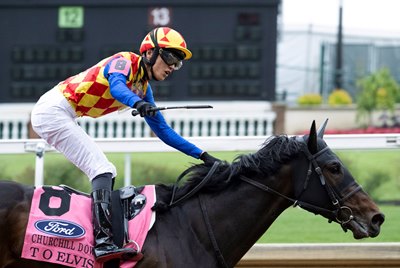
T O Elvis wins the Churchill Downs Stakes
When the Japanese-campaigned T O Elvis defeated a talented field in the $939,600 Churchill Downs Stakes (G1) May 2 at the race's namesake track, his breeders Jeff and Melissa Prunzik were celebrating in their Pittsburgh living room.
"Melissa, our youngest daughter Ryan, and I were over the moon," Jeff Prunzik recalled after T O Elvis gave his breeders their first grade 1 victory.
The Prunziks privately bought the Volatile colt's dam, the Curlin mare Stopshoppingdebbie , soon after they purchased Stone Bridge Farm in Lexington in 2017.
"I like to buy mares that show racing ability, and she had won multiple stakes while racing in Washington state," Prunzik, a commercial realtor from Pennsylvania, explained.
Jeff Prunzik didn't grow up around bluegrass or broodmares, but around ballfields, watching the Kentucky Derby (G1) and Breeders' Cup on television with his father and a rotating cast of friends. Racing was a big‑event spectacle, another event to follow for the sport-minded Prunzik.
"I played basketball in college, and have followed many sports through the years," he explained.
The success of his western Pennsylvania commercial real estate business facilitated what became a two-year search for the farm of his family's dreams.
During their annual trips to the Mississippi farm where Melissa was raised, the Prunziks would travel through Lexington and found themselves taken by the majestic scenery.
"We often would stop for the night and we loved to drive around the Kentucky roads, like the tourists we were, admiring the miles of fences, the horses grazing in their pastures, and we started dreaming of what it might be like to own a farm ourselves," Jeff Prunzik said.
The Prunziks looked at multiple properties while learning, in parallel, how the industry actually works: the economics of boarding, the rhythms of the sales calendar, the differences between weanlings, yearlings, and 2‑year‑olds in training. When the Prunziks finally saw Stone Bridge Farm, they knew it was the property they had been looking for.
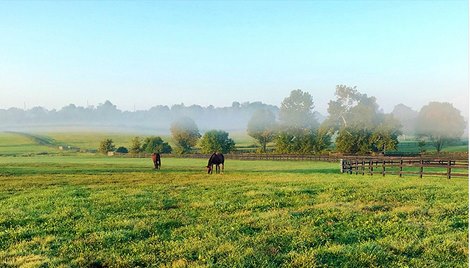 Stone Bridge Farm
Stone Bridge Farm had a storied past. Developed by noted Kentucky horseman Robert Courtney Jr., it had already raised numerous celebrated Thoroughbreds such as millionaire Fit to Fight, the undefeated Meadowlake, and champion racemare Meadow Star, to name a few.
"It was a turnkey purchase," Prunzik recalled. "It was obviously a well-run farm, so keeping farm manager Juan Piedra and his assistant, Maria Figueroa, well, they have been there a combined 29 years, I believe. So they stayed on."
Courtney even became his first client, keeping two broodmares on the farm.
Surrounding himself with experienced horsemen has been a deliberate choice for Prunzik. On the farm side, Piedra and Figueroa handle the day‑to‑day, while chief operations officer Kali Kleinfelt runs operations and client relations.
In the broader industry, Prunzik said, "I leaned on the expertise of consignors like Leslie Campion at Paramount, and the stallion farm contacts at Spendthrift and Darley have also been very helpful. Trainer Robbie Medina has helped me select 2‑year‑olds in training and also offered advice on matings."
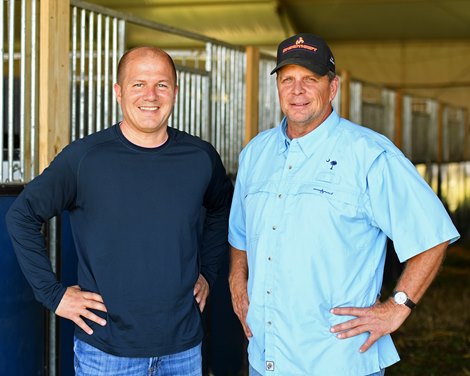 Jeff Prunzik (left) and Mike Heitzmann with the Stone Bridge Farm consignment at the 2017 Fasig-Tipton Kentucky October Sale
Asked what advice he'd give a novice, Prunzik didn't hesitate: "Find someone educated, but more importantly, trustworthy, and then immerse yourself in every facet of the game.
"We don't have any Thoroughbred racing near Pittsburgh, but everyone I invited to visit Keeneland has just been bowled over," he continued. "They had just never been exposed to it before."
With that exposure came an interest in participating.
In those early days, "a dozen or so friends each put in a little money to buy three weanlings," explained Prunzik. "We did well enough to make money on all three, and word began to spread. Now we have 59 people in that same syndicate.
This year, "between the farm and the syndicate, we have 29 mares. The rest are client mares," Prunzik continued. "We range between 95 and 120 horses at any one point, which will be a combination of mares, weanlings, and yearlings." He typically adds one to three broodmares a year and buys one or two 2‑year‑olds from training sales.
In a business where "all your plans can be scrapped at any second," Prunzik explained, "our approach is incremental but intentional."
If the headcount suggests scale, the business model explains sustainability. Alongside public auction appearances, Stone Bridge has developed a quiet but meaningful private‑sale channel.
"Anywhere from three to five groups ... come out every year looking to potentially buy something privately, and I'd say on average every year we probably sold one or two privately," he noted. "This is how T O Elvis was sold as a yearling."
For all the romance of foals in the field, Prunzik was blunt about the emotional math.
"I never thought there'd be so many lows," Prunzik admitted. "From losing foals to seeing promising horses derailed in training, there is a lot of attrition.
"In most sports, a .500 record is the mark of mediocrity. In racing, a 20 to 25% win rate is a badge of honor. The lows are low and often, but when a horse like T O Elvis breaks through at the grade 1 level, those highs make the reverses bearable."
When pondering the future of the Thoroughbred business, Prunzik stated he would like to see a united front come together for the betterment of the sport.
"If you could have a governing body, like all the other sports, it puts everyone on a level playing field," he said. "I think that's the key to success, if you can have a governing body or a commissioner.
"Whose role is it to really market the industry? The absence of a single entity responsible for selling racing to the public has left the sport underexposed, especially to younger fans."
Prunzik sees social media as an obvious tool, but not a cure‑all.
"What's missing is someone to coordinate and fund a coherent national effort," he said. "I do think there should be an increased role for social media, but I think if you have a governing body, then they could allocate X amount of dollars per marketing for all the tracks across the country. If that happens, and if HISA can continue to make progress on the regulatory side, the sport still has the raw material for a comeback. If we could market the industry to the right people, to the younger generation, and get more people involved, it's really a great industry. I think it could really grow."
In the end, his optimism is as measured as his expansion. He talks about governing bodies and social media campaigns in the same breath as lost foals and 20% win rates, fully aware of the highs and lows that come with the commercial marketplace. What keeps him in the game is not just the prospect of another T O Elvis, but the people he's met—the farm staff up before dawn, the consignors and stallion managers who take his calls, the partners who keep signing up for one more horse.
The man who once watched the big races on television with his father now helps breed the horses being broadcast to the world, betting that if the sport can finally present a unified face, there will be room for operations like his to keep growing step by careful step.