
Dollars & Sense: Two Sets of Numbers, Different Stories
Image:
Description:
Photo: Coglianese Photos
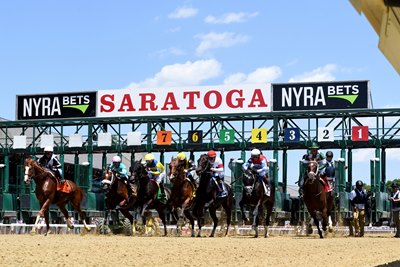
Horses break from the gate for the first race July 3 at Saratoga Race Course, opening the summer meet
Industry numbers telling two different stories—two different approaches—arrived in my email minutes apart on July 6.
The first to arrive, the Thoroughbred Economic Indicators for the second quarter of 2026, painted the all-too-familiar picture of a steady decline in wagering on United States racing. Not sure who hasn't yet received the memo but the current approach on the pari-mutuel side of things is not working.
The second to arrive, a report on New York Racing Association handle for the first three days of the Saratoga Race Course meeting, displayed some hope that taking a bit of a different approach could bring more people to the sport and, ultimately, more money from pari-mutuel racing for purses and tracks.
As for the first set of numbers, pari-mutuel handle on United States races for the first half of 2026 is down 4.52%. That's the rate of decline for the first half of the year, according to the Thoroughbred Racing Economic Indicators report released Monday by Equibase that highlights handle and purse figures for the month of June, second quarter, and first six months of 2026.
Not only does the handle decline for the first half of the year continue the downward trend we've seen since the COVID bump when racing was one of the few gambling options available, but it is also outpacing the decline in race dates and races. Besides the decline in overall wagering on U.S. races, the average wagering per race day was off 2.41% to $3,298,243.
READ: Purses Edge Up Despite Continued Handle Decline
These declines have occurred at a time when computer-assisted wagering is contributing billions of dollars in handle. Despite that handle, racing has squandered the 11.8% COVID bump it saw in handle in 2021 when wagering on U.S. races reached $11.545 billion. In 2025, handle on U.S. races fell to $11.037 billion, matching the 2019 total. If pari-mutuel handle doesn't improve in the second half of 2026 and ultimately finishes down 4.52% (or worse) for the year, the sport will see its lowest handle on U.S. racing since 1995—and that's not figuring in inflation.
Seeing that might lead one to question if the commitment the sport has made to CAW in the form of high rebates is truly working for the sport?
One racing association trying a different approach is NYRA, which has put in new guardrails on CAW that aim to reduce the severity of late odds changes in such pools as the win and exacta pools by requiring CAW play to be entered in those pools earlier than "retail" (everybody else) players.
READ: NYRA Seeing Reduced Volatility in Late Odds Changes
The approach shows some signs of hope, at least for big weekends. While the changes have resulted in an overall reduction in CAW play on NYRA racing, on two of its biggest weekends, retail players have made up that difference.
As we noted in this column a few weeks ago, the Belmont Stakes Racing Festival dates saw a small bump in handle despite a nearly $17.9 million decline in handle from CAW players on those comparable dates in 2025. Retail players increased their wagering that week by more than $20 million—up 12.7%—to provide a bump in total handle.
On Monday, NYRA reported more encouraging numbers as all-sources handle for the opening weekend of the Saratoga meeting, July 3-5, improved 1.7% to $69,896,899 when compared with the corresponding three dates of 2025. NYRA saw this improvement despite a 40% decline in CAW wagering year over year to $9,239,447. That's a decline of more than $6.1 million for CAW players. Non-CAW handle for these three dates saw a 13.8% increase to $60,657,451—a $7,356,613 spike.
Keep in mind that the two biggest reasons to track handle trends are that it's a key economic driver for the sport and it's a measure of the sport's popularity. That's where this latest 1.7% bump in handle is encouraging on a couple of fronts. Besides handle being up, the spike in retail handle is of particular interest as, in general, it generates more for purses and tracks than CAW handle because that play receives large rebates. Secondly, as retail players made this handle increase possible, it's safe to say that this likely involved more players being engaged with these cards.
READ: Dollars and Sense: New Approach, Strong Belmont Wagering
We'll concede that things are early in the process and attention also has to be paid to the day-in, day-out numbers. At the least, though, the NYRA big-race success points to the possibility that rules can strike a better balance between CAW and retail players. And, especially with the overall numbers continuing to paint the same picture, the NYRA numbers suggest it's worth at least trying some new ideas.