
NY Gaming Commission Authorizes Claiming Purse Increase
Image:
Description:
Photo: Coglianese Photos
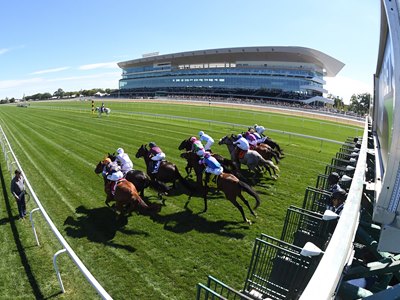
Racing at a rebuilt Belmont Park
The New York State Gaming Commission Oct. 9 received an update on advanced diagnostic imaging intended to identify potential injuries in racehorses, reviewed barn fire safety efforts, and authorized consideration of an increase in the purse-to-claiming-price ratio for claiming races.
The last move would allow purses to be up to three times a horse's claiming value in the state, up from 2.8-to-1, but would remain subject to continued safety measures and monitoring.
After a spike in claiming-horse injuries 15 years ago and a subsequent review with recommendations, New York has restricted this ratio—with gradual increases over time—as an equine safety measure. Beyond that change, recent protocols for all race types have created a safer environment for racehorses.
New York tracks favor higher claiming race purses to avoid a competitive disadvantage against tracks in nearby states with rich claiming purses. Field size has been an issue in New York, as in many states, making it harder for tracks to fill races with deep fields that bettors embrace.
Equine medical director Dr. Scott Palmer recommends maintaining enhanced scrutiny of claiming horses, keeping claiming race numbers relatively consistent with non-claiming races and continuing to monitor fatalities.
Commissioner John Crotty, who is leaving the commission and was repeatedly thanked by his fellow commissioners for his service toward the end of the meeting, asked Palmer to provide the commission with a brief review in about six months.
Barn Fire Safety Review Continues
Several commissioners reported having visited every Thoroughbred and harness racetrack in New York following a June 16 fire at Saratoga Casino Hotel that killed 17 Standardbred horses.
Tracks have installed smoke or heat detectors, but some systems have triggered false alarms because of dust and other conditions common in barns. The commission is examining specialized detection technologies designed for agriculture.
A follow-up report is scheduled for the commission's next meeting.
Two at-Risk Horses Identified With New Technology
Executive director Robert Williams reported that the recent use of standing computed tomography and positron emission tomography machines at Cornell Ruffian Equine Specialists, next to the newly reopened Belmont Park, has already yielded benefits.
The machines can detect increased bone metabolic activity across multiple planes and point to bone abnormalities and remodeling.
"In an encouraging start to the first week of operation, the equipment was able to identify areas of pathology in two horses that were free of clinical signs of lameness," Williams said during his report. "While there is no certainty that the lesions identified would have led to catastrophic injury, these horses were marked for further veterinary examination that otherwise would not have been undertaken, but for the new imaging."
In other NYSGC action:
- The commission approved proposed rules restricting the use of artificial intelligence and algorithmic profiling to personalize wagering promotions and suggest bets. Commissioners requested academic and technical review given the quickly unfolding AI landscape.
- Commissioners also advanced rulemaking proposals to modernize electronic race entries and how racing information is provided to the public, while allowing racetracks to assume or contract out ownership, stable name, and silks registration services.
- The commission sustained several hearing officer recommendations after jockeys appealed stewards' rulings, keeping a three-day careless riding suspension for Manny Franco but not one for jockey Kendrick Carmouche. Additionally, the commission sustained a hearing officer's determination that steeplechase jockey Gerard Galligan did not violate NYSGC rules when stewards suspended him 15 days and fined him $1,000 for not carrying the designated weight while riding a horse during the summer of 2025 at Saratoga Race Course.