
Texas Stakeholders Optimistic on Return of Simulcasting
Image:

Description:
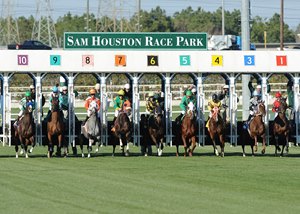
Photo: Coady Photography
Racing at Sam Houston Race Park
After years of conflict over the implementation of rules under the Horseracing Integrity and Safety Authority, key Texas horse racing stakeholders are optimistic that a path exists to restore interstate simulcasting while the legal dispute over HISA's federal oversight continues.
Wagering on Texas racing has been curtailed since the Texas Racing Commission directed tracks to stop exporting its signals to out-of-state outlets in 2022, in defiance of HISA's regulatory framework.
According to Sam Houston Race Park general manager Bryan Pettigrew, the Houston track generated approximately $100 million in interstate simulcast handle in 2022. That annual figure later fell to about $10 million after the export signal was cut.
In terms of bottom-line effects, "That equates to between $3 and $4 million in purses and operating income for the track each," he said.
Penn Entertainment is a part owner of Sam Houston Race Park.
Wagering remains available at operating racetracks and other authorized locations within Texas, and when distributed internationally, such as to Woodbine in Canada, for example. Texas does not permit legal advance-deposit wagering or off-track wagering.
The TRC, along with the Texas Horsemen's Partnership and Global Gaming—the owner of Lone Star Park—were among the plaintiffs who sued HISA, questioning its constitutionality in one of numerous lawsuits that sprang up in different states. The TRC argued that Texas racing law authorized it to regulate the sport in Texas.
Thoroughbred racing continued under TRC enforcement in Texas while courts across the country weighed HISA's constitutionality. Unlike states such as Louisiana and West Virginia, Texas did not receive preliminary injunction relief that would have allowed it to operate under TRC rules and simulcast out of state.
Now, about five years into the legal challenges, HISA's constitutionality remains unsettled. Only a United States Supreme Court ruling is likely to settle HISA's legality, but whether the Court hears the case and, when, remains unsettled.
Texas stakeholders, meanwhile, want to restore simulcasting without waiting any longer without waiting for litigation to conclude.
"So, in our view, we've got to get the signal back, and our goal is to have that signal up and going by the time Sam Houston opens up in December," Texas Thoroughbred Association president Phil Leckinger said.
Commission Leadership 'Listening' to Industry
Leckinger credited Texas Racing Commission executive director David Holmes with being willing to hear industry stakeholders' concerns. Holmes was appointed in February, replacing Amy Cook, who resigned last fall.
"I think David has done a good job in listening to the people that really have the skin in the game down here," Leckinger said.
Reflecting that outreach, the commission has placed the "Status of Horse Racing in Texas" on the agenda for the second of two consecutive morning meetings Oct. 14 in Austin. The session will include panel discussions with breed associations and representatives of horsemen, followed by a panel on Texas racetracks. Pettigrew and Leckinger are among those scheduled to speak before commission chairman Judge Robert Pate and other commissioners.
BloodHorse will cover the meetings on-site.
Holmes said the agenda followed Pate's suggestion that commissioners hear directly from industry participants about the state of Texas racing.
"He said, 'Let's have a meeting where we just discuss that and really get a good picture from all the stakeholders in Texas, what the current state of industry is in Texas," Holmes said. "It can be anything they need to talk about. Whether it's our rules holding them back, then they need to tell us that. ... This is a time that everybody can kind of get on the same page and hear from one another and understand the needs they have going into this legislative session."
Pettigrew believes a workable arrangement among Texas tracks, the commission, and HISA is possible.
"We feel like we're in a good position for them to say, 'Hey, we can export the signal from Sam Houston, and the track will pay its dues to HISA, and we can work together making racing safer in Texas,'" Pettigrew said.
He said the goal would be "working together until the Supreme Court rules."
 Bryan Pettigrew
Such an arrangement could require Texas tracks to change their operations to align with HISA protocols and the requirements of its enforcement arm, the Horseracing Integrity and Welfare Unit. Those changes might include hiring a veterinarian or additional safety officials.
Some requirements already seem to be in place. Thoroughbred blood and urine samples collected in Texas are tested at the Kenneth L. Maddy Equine Analytical Chemistry Laboratory at the University of California, Davis, an official contracted laboratory for HIWU under HISA's Anti-Doping and Medication Control Program.
HISA outside general counsel John Roach said the authority would welcome an end to the standoff.
"HISA would love for Texas tracks to send their signal out and be subject to HISA regulations," Roach said. "All the discussions were very cordial and informative, but I haven't been told that the signal is going to go out for the upcoming meet.
"I don't think any (formal) agreement is necessary. The signal simply needs to be exported."
Roach's statement pointed to tracks in states such as Ohio and Oklahoma, where racing operates under HISA and signals are distributed out of state despite opposition to federal authority in those states' political and regulatory environments. Global Gaming owns and operates Remington Park in Oklahoma, along with Lone Star Park.
Global Gaming and Penn Entertainment, co-owner of Sam Houston and its operator, appear invested in Texas long term, partly as a strategic play for potential casino legalization, positioning themselves to immediately convert or expand their existing physical properties into lucrative racinos if the state ever expands its gaming laws. Political opposition to expanded gambling in Texas could soften under new political leadership in the years ahead.
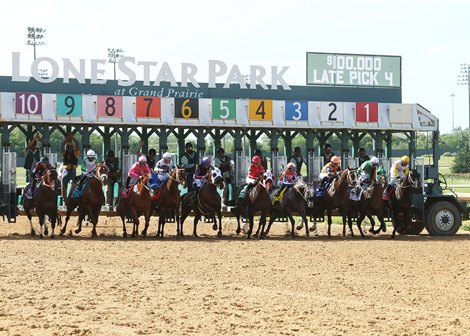 Racing at Lone Star Park
Restoring Texas simulcasting would also bring state assessment payments back into HISA's funding structure, reducing fees for other jurisdictions. Roach said he did not know the precise amount HISA would collect, noting that the figure had not been budgeted and that previous assessments were calculated under a different methodology based on purses and starts. Under the current system, which bases assessments solely on starts, Texas participation could generate hundreds of thousands of dollars between the state's two Thoroughbred tracks, Sam Houston and Lone Star.
Assessments may be a relatively small price to pay compared with the millions in funds lost.
Horse Industry Escrow Account Has Served as A Lifeline
Although the state's Horse Industry Escrow Account, which directs sales tax collected on equine-related goods and services toward the industry, has provided millions of dollars for purses, tracks have reduced racing dates and purses amid lost simulcast revenue.
The effects have also reached the breeding sector. According to The Jockey Club's latest statistics, only 230 mares were bred in Texas in 2025. Leckinger estimated that number would fall somewhere between 200 and 210 in 2026. Annual mares-bred numbers from 2019-23 were typically about twice that level.
"You have to have an incentive to want to breed a horse," he noted.
"And we lose all the way around from an accredited Texas-bred perspective because you know a percentage of the breakage (from wagering dollars) comes back to the breed organizations, and that helps fund many of our programs," he added. "So from stallion incentives, mare incentives, we just haven't had those dollars available to us."
Sam Houston appears poised to pick up stables, as uncertainty grows over the race meeting at Turf Paradise in Arizona. But recruiting horses is a tougher sell when out-of-state owners are told they won't be able to watch and wager on their horses via simulcasting, as they normally would.
Despite the setbacks, Leckinger remains upbeat about the future. He praised state legislators' willingness to support the industry through the HIEA program, evidence that cooperation can produce meaningful results for a vital industry.
"(That) has proven that when everybody cooperates together and works together, it makes a difference," he said.