
Kat’s Eye: Morning with the Reeves at Gulfstream
Image:
Description:
Since relocating to Georgia from sunny San Diego last year, I’ve been anxiously monitoring the efforts of the Georgia Horse Racing Coalition as they endeavor to bring Thoroughbred horse racing to my new home state.
In January, the bill to legalize pari-mutuel wagering cleared the Georgia Senate’s Utilities and Regulated Industries Committee, and we now await a vote by the full Senate, which would put the measure on the ballot in November if it were to pass.
With the great hope that the citizens of Georgia will have the opportunity to bring this sport closer to home, I’m traveling to neighboring states that have Thoroughbred racing to share stories and images of the work that goes on behind the scenes.
Last weekend, I made my first trip to Gulfstream Park, the historic venue in Hallandale Beach, Fla. that held its inaugural, four-day meeting in February 1939. The racetrack is north of Miami Beach and sits about three-quarters of a mile inland, allowing for the enjoyment of a delicious breeze off the Atlantic Ocean.
On this morning, as I pulled my rental car into a parking spot just 20 yards from the rail separating the racetrack from the path traveled by spectators, I was meeting Dean and Patti Reeves of Reeves Thoroughbred Racing, owners of 2013 Breeders’ Cup Classic winner Mucho Macho Man.
The Reeves are based in Suwanee, Ga., just outside Atlanta, where they both own and run successful businesses. But my visit with them was in their capacity as Thoroughbred owners and active members of the leadership team striving to bring the sport of kings to Georgia.
As the sun rose over the toteboard behind the track’s finish line, horses worked at varying paces along the home stretch and I walked toward the grandstand to meet the Reeves, who were waiting for a 3-year-old trainee to work under the guidance of trainer Kathy Ritvo.
The thing you notice immediately about this team, and Gulfstream Park in general, is approachability. Warm smiles and laughter punctuate the morning, revealing a team that spends a lot of time together and enjoys their working relationships.
Before long, the chestnut colt we had been waiting for came galloping toward the finish line with exercise rider Nick Petro aboard.
After watching numerous horses work, the thing that struck me most, outside of the horse’s athletic good looks, was the fact that I could barely hear him coming. Rather than pounding the ground, this horse approached in what could easily be called stealth mode, using his energy with such efficiency that he seemed to glide past us. I’ll be keeping my eye on this one.
Next it was time for the 2-year-olds, a group of four young horses the Reeves had brought down from training in Ocala, Fla. to begin their on-track education just a few weeks earlier. To watch these horses, we left the grandstand and traveled to the barn and the viewing areas on the “backside.”
I love the barns, and I even stay back to watch races from that side of the track from time to time. In the morning, it’s busy with horses coming out to work, cooling down after work and getting bathed and fed. This is the heart of the sport … the place that pumps the blood that moves the industry. It is fueled by hundreds of people doing jobs you’ve never considered.
I’ll be sharing stories in future installments of grooms and hot walkers, vets and dentists and farriers, exercise riders and trainers, outriders and pony horses —everyone working with the goal to prepare for races, keeping horses and riders safe and healthy. If you are on the backside in the morning you will see that it is hard work carried out by people devoted to their love of horses and racing.
While every role has its challenges, as a rider myself, I have huge respect for exercise riders, whose job it is to work horses, experienced and young alike. It’s the young horses with big, dewy eyes and long, skinny legs that were heading to the track now with Nick and fellow exercise rider Daniel Vera piloting.
If you know little about horses, know this: they are prey animals and by instinct, they run from trouble. The most difficult, and most important, thing to establish with any horse, especially a young horse, is trust. If you are in the saddle and your horse encounters something it sees as a threat (read: scary plastic bag on the ground), if your horse trusts you, you’ll avoid most perils.
But trust is tricky. It takes time and patience, which are not the same thing. And with horses, it takes a gentle firmness that lets them know who is in charge.
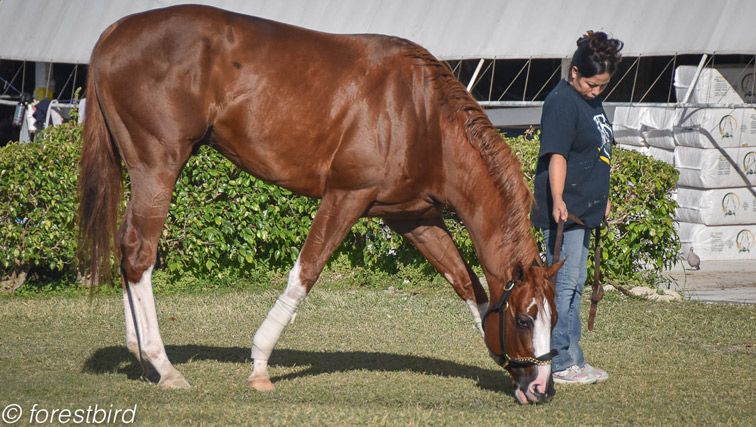
The “babies” are fun to watch, as they start to understand the routines and learn to race or that moment when you see their ears move forward or back, when something falls into place for them. I was especially impressed with one young horse — a bay colt — that walked through his morning routine with calm that is rare for a 2-year-old. He stood still for his bath, and didn’t even lift a foot when his groom wrapped his legs with bandages out of the ice bucket.
His first race has yet to be determined, but when it is, I’ll be there.