
'Interesting Case' Horsepower Wins at Keeneland
Image:
Description:

Photo: Coady Photography/Keeneland
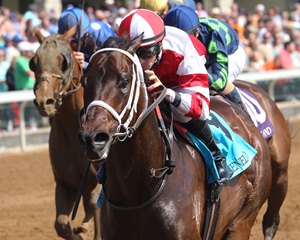
Horsepower wins Keeneland Race 6 April 20, 2016.
Fox Hill Farm's Horsepower added another unlikely victory to his past performances April 20, making strides for science.
Highly regarded as a $420,000 purchase from the 2011 Keeneland September yearling sale, the Bernardini runner prepped for his 2-year-old debut for trainer Steve Asmussen in 2012 in company with eventual grade I winner Justin Phillip . But Horsepower severely chipped a lower knee joint in his first race in July at Belmont Park that season, putting his career on hold.
"That's usually it, there's no hope that you can retain your class," said Victoria Keith, executive assistant to owner Fox Hill owner Rick Porter. "We were going to try, though, because he had talent. And Dr. Bramlage said, 'Let's try stem cells in the knee, it's this sort of new therapy we're doing; it's not going to hurt anything.'"
"He's an interesting case," Rood & Riddle's Dr. Larry Bramlage recalled. "About six months after treatment, we re-checked him and he was filling in the area he lost, which is something we don't usually see. When they lose an area of joint surface, it's usually gone."
Horsepower started back in training, this time with Chad Brown, but fractured a spur and had to have it removed. He came back again to run fifth at Laurel Park on Nov. 28, 2013, then was last of eight Dec. 18 when entered for a $50,000 tag at Aqueduct Racetrack.
"Rick said, 'Let's retire him, we don't want something to happen to him,' " Keith said. "He ended up coming to my house and getting turned out in the paddock with my two Tennessee Walkers."
In 2015, with spring rolling around, Keith decided to look for a second home and career for Horsepower. She asked Bramlage if he was curious enough about his former patient's progress to take a set of X-rays. The veterinarian agreed, and was surprised to find perfect healing.
"The knee looked amazingly good—strong and solid," Bramlage said. "He was a horse I would have thought had no chance, no matter what you did. No matter how much time you give a horse that has the injury he had, normally they don't reconstitute the bone. But something made him grow the bone back to virtually the same size and shape that it was as a 2-year-old, so I think the stem cells might have had something to do with it."
Larry Jones took on the project of bringing Horsepower back, and on Jan. 30, sprinting six furlongs in a $19,000 maiden special weight in Texas, the now 6-year-old became a winner.
"For me, it was special because this is the first Fox Hill Farm horse who was a pet out in my yard, and I also figure he's running for science," Keith said. "We can't know at what point in time his bone was perfect again... we know it took at least 1 1/2 years, possibly two years. But it could spell that horses that get chips in the lower joint of their knees don't have to be retired."
Despite two losses at Fair Grounds Race Course & Slots over the winter, Horsepower rebounded to gamely win a 6 1/2-furlong claiming race April 20 by 2 1/4 lengths while running for a $40,000 tag with no takers at Keeneland.
"We've done half-a-dozen similar horses with some encouraging results in areas where we hadn't previously considered stem cells to be effective," Bramlage said. "When a 2-year-old that's shown a lot of ability gets an injury we think is without a resolution—and these large lower joint chip fractures certainly are—you have to have special situations, but I certainly think we should discuss this as an option with owners. I don't think we'll be treating every knee chip with stem cells, but there probably is a place for the treatment. Horsepower demonstrated that stem cells may actually have the ability to impact bone as well as soft tissue, and made us think that maybe we've only scratched the surface."