
Symposium Documents Racing's Racino Problem
Image:
Description:

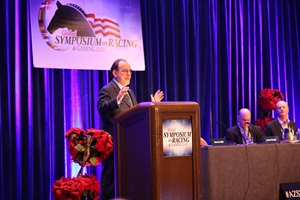
Photo: The Race Track Industry Program
Lonny Powell, CEO of the Florida Thoroughbred Owners and Breeders Association
Three panelists with extensive experience documented the strained relationship between pari-mutuel interests and racinos during the final session of the first day of the Global Symposium on Racing and Gaming Dec. 6 near Tucson, Ariz.
The presentation, entitled “Racinos: Is the Marriage Headed for Divorce?” documented the mounting pressure felt by racetracks that have inked deals to share in profits with racino companies that initially received their gaming licenses by agreeing to help support live racing through profits on slot machines and other casino games.
Lonny Powell, CEO of the Florida Thoroughbred Owners and Breeders Association, kept the marriage theme throughout his talk based on his experiences in the Sunshine State, where Thoroughbred racing is fighting a movement that seeks to decouple racing and racinos. Decoupling would eliminate a requirement that tracks must offer live racing in order to keep their slot machines.
“The marriage is strained and verging on irreconcilable differences,” Powell said. “The racing part has been de-emphasized, with racino owners embracing fewer racing dates and less emphasis on racetrack marketing.”
Powell provided a series of pointers for Thoroughbred interests in these kinds of battles. He urged being pro-active and sitting down with government officials, regulators, and casino interests to find out intentions and commitment to racing. He also said the Thoroughbred industry must unite and develop a plan in order to wage these fights.
“Righteous indignation doesn’t get the job done,” he stated. “Be prepared with new, independent economic impact studies to demonstrate the worth of the industry. While the gaming interests made guarantees they don’t want to keep, we have been guilty of taking profits from racino money without putting them back into our facilities and into marketing.
“This industry is being challenged, and we have to be prepared to think big.”
Chris McErlean, vice president of racing for Penn National Gaming, also used the marriage theme to document where in the process various states find themselves today as far as their courtship with racinos and live racing. He noted Ohio is in the Honeymoon Stage since VLTs at racetracks were approved in 2012. Purses are up nearly 200% for racetracks in the state in 2015 compared with 2012. Race dates are up 10%, and breeding is growing as well.
“Ohio is an early success story,” said McErlean, “but there are 11 casinos in the state now, compared to zero a few years ago, and they will provide competition.”
McErlean placed Pennsylvania in the Seven-Year Itch category, where the revenues have reached a plateau and the racino owners are asking ‘Is this the best way to continue?’
“There have been money grabs from the legislature; the Race Horse Development Fund has been raided several times,” he said. “Taxes have also been raised on table games.”
Handle at the three Thoroughbred tracks and three Standardbred tracks, peaked in 2009 and has been going down since, with the development fund going from 12% to 10% of racino profits. The fund has delivered $1.89 billion to purses, breeding, and a health and welfare program.
McErlean also put New Mexico in the Seven-Year Itch division. He placed Maine and West Virginia in the Last Stages category, stating that intense pressure from neighboring states has cut into West Virginia, which was a leader in racinos. Purses there have gone from $12 million in 1996 to $89 million in 2004 and back to $43 million in 2015.
Greg Martin, vice president of wagering for the Woodbine Entertainment Group, documented the severe roller-coaster ride in Ontario after the provincial government cancelled its Slots at Racetracks program in 2013.
“We learned that if you don’t have a lobbyist, you should get one,” joked Martin. He noted that after VLTs were approved at racetracks in the province in 1996, purses and wagering soared, barns were rebuilt, and a new track surface installed. The agreement, between tracks and the Ontario Lottery & Gaming Corporation, earmarked 10% of racino profits to the tracks and 10% to purses. After the 'divorce,' Martin said the industry lost 9,000 jobs and 3,000 horse owners, while broodmares were moved to other jurisdictions.
A new administration has reached a settlement with the province’s tracks with fixed purses, which has led to handle growth again. Martin said the lesson from the ordeal is that WEG is working on becoming self-sufficient with an eye toward getting off the subsidy model.
In an earlier panel on how to use academics and data to improve horse racing, Professor Mick Peterson noted how a team of entomologists were the heroes in solving Mare Reproductive Loss Syndrome in 2001.
“We need to establish a front door from academia to help support the horse racing industry,” Peterson said.
Professor Marshall Gramm, a horse owner, noted that economics can help answer racetrack questions on everything from takeout to peak performance age of horses.
“Data promotes research,” said Gramm. “The growing influence of analytics in other sports is data-driven, whereas access to data for racing can be limited.”
The symposium continues through Dec. 7.